
7 Best Hiver Alternatives: Features, Pricing, Pros & Cons
On this page
- Key differences (the 5 things that matter most)
- Category fit: what Hiver is (and what to evaluate)
- Quick comparison: best Hiver alternatives at a glance
- Alternative 1: Master Inbox
- Alternative 2: Gmelius
- Alternative 3: Front
- Alternative 4: Help Scout
- Alternative 5: Zendesk
- Alternative 6: Missive
- Alternative 7: Drag
- Which alternative should you pick?
- FAQs
- Final recommendation
If you're managing team communication inside Google Workspace, you've likely come across Hiver. It's a popular tool that turns Gmail into a collaborative help desk. But as teams grow and needs evolve, many start searching for Hiver alternatives that offer different features, better pricing, or a more specialized focus. Whether you're a B2B SaaS founder, a sales leader, or a customer support manager, choosing the right shared inbox tool is a critical decision that impacts team efficiency and customer satisfaction.
This guide breaks down the 7 best alternatives to Hiver, helping you compare them based on what matters most. We'll cover everything from direct Gmail-based competitors to powerful standalone platforms, with a special focus on tools built for specific use cases like outbound sales. Our goal is to give you a clear path to choosing the right solution for your team's unique workflow.
Key differences (the 5 things that matter most)
- Primary Use Case: Hiver is built for customer support. Alternatives like Master Inbox are purpose-built for sales and SDR reply handling.
- Platform vs. Plugin: Hiver, Gmelius, and Drag live inside Gmail. Front, Help Scout, and Zendesk are separate, more powerful applications.
- Channel Integration: Hiver is email-centric. Master Inbox adds LinkedIn, while platforms like Front add social media, SMS, and more.
- Workflow Style: Hiver uses a traditional ticketing and assignment model. Drag uses visual Kanban boards, while Master Inbox uses sales-focused lead status labeling.
- Scalability & Complexity: The options range from simple Gmail add-ons to full-fledged enterprise suites like Zendesk, with vastly different pricing and setup requirements.
Category fit: what Hiver is (and what to evaluate)
At its core, Hiver belongs to the Shared Inbox & Help Desk Software category. When evaluating alternatives, consider these key criteria:
- Platform vs. Plugin: Do you want a tool that enhances Gmail, or a separate, dedicated application?
- Channel Coverage: Does the tool handle just email, or does it unify other channels like LinkedIn, social media, or SMS?
- Use-Case Focus: Is it designed for customer support, outbound sales, or general project management?
- Collaboration Features: Look for collision detection, internal notes, and clear assignment rules.
- Automation Capabilities: Can you create rules to automatically tag, assign, or archive conversations?
- Reporting & Analytics: How well can you track team performance, response times, and other key metrics?
- Integration Ecosystem: Does it connect with your CRM and other critical tools?
- Scalability: Will the tool grow with your team, or will you need to switch again in a year?
Quick comparison: best Hiver alternatives at a glance
| Alternative | Best for | Biggest strength | Biggest tradeoff | Pricing approach | Switching from Hiver |
|---|---|---|---|---|---|
| Master Inbox | B2B outbound sales teams | Unified LinkedIn + Email inbox | Not a traditional support tool | Per-user subscription | Medium: workflow shifts to sales |
| Gmelius | Teams wanting project management in Gmail | Kanban boards & automation | Can make Gmail feel cluttered | Per-user subscription | Easy: very similar concept |
| Front | Multi-channel customer communication | Unifies many communication channels | Higher price point | Per-user subscription | Medium: moves workflow out of Gmail |
| Help Scout | Simple, dedicated help desks | User-friendly and clean interface | Not integrated into Gmail UI | Per-user subscription | Medium: moves to a separate platform |
| Zendesk | Large teams needing an all-in-one suite | Comprehensive feature set | Complex and expensive | Per-user subscription (complex tiers) | Hard: major platform migration |
| Missive | Internal and external collaboration | Strong chat & collaborative features | Can be too feature-rich | Per-user subscription | Medium: standalone app adoption |
| Drag | Visual, Kanban-based teams | Turns Gmail into a Trello board | Less powerful reporting/SLAs | Per-user subscription | Easy: stays within Gmail |
Alternative 1: Master Inbox
Best for: B2B outbound sales teams looking to manage and track replies across both email and LinkedIn.
Why it’s a strong alternative to Hiver
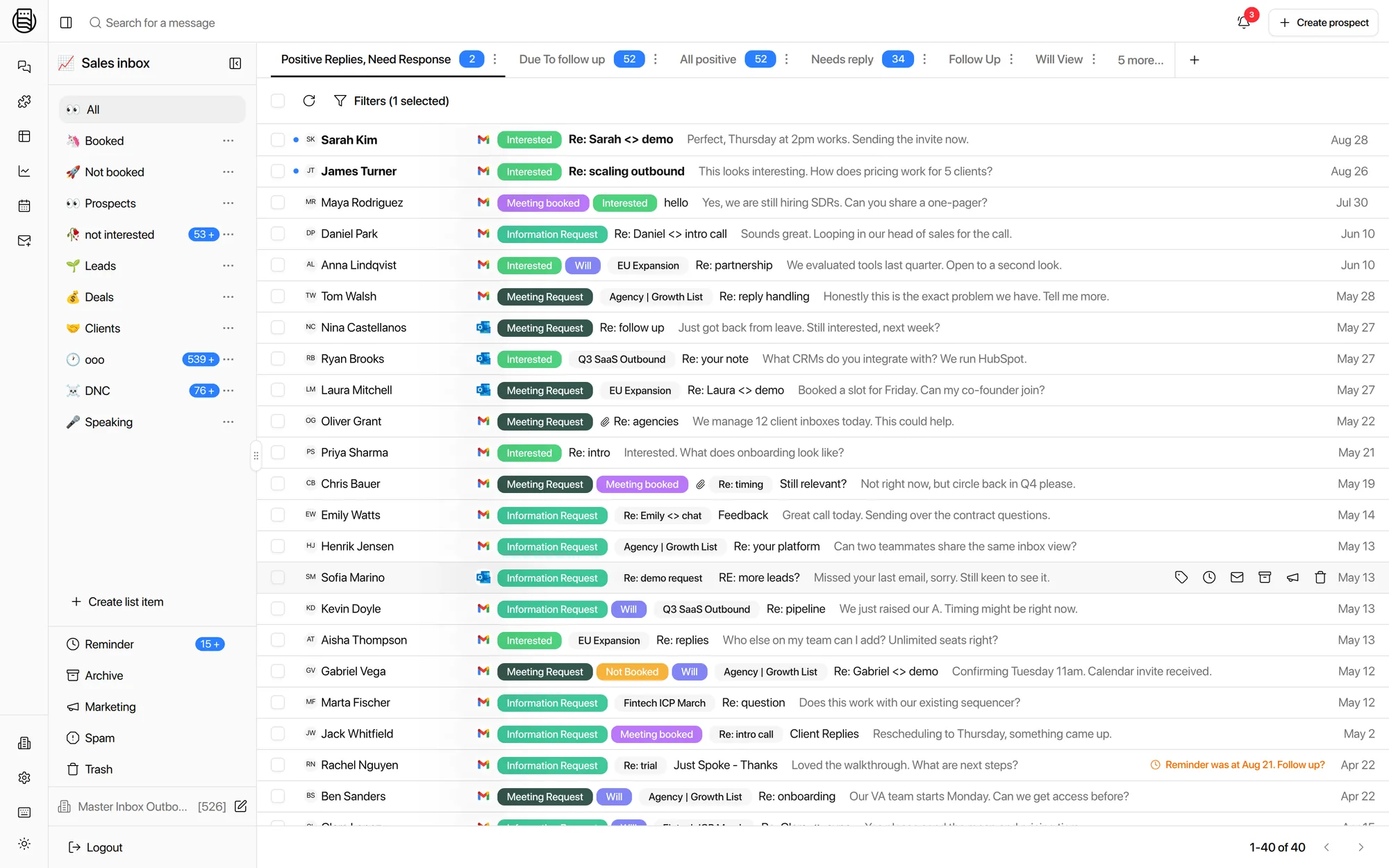
While Hiver excels at turning Gmail into a reactive customer support hub, Master Inbox is built for proactive outbound sales teams. It addresses a critical gap that Hiver doesn't: managing sales conversations across multiple platforms. By creating a Master Inbox - Combine LinkedIn + Email, it allows SDRs and account executives to see and manage all their lead replies in one place, preventing missed opportunities and streamlining follow-ups.
If your primary goal is not closing support tickets but rather managing leads and booking meetings, Master Inbox is a fundamentally better fit. It's designed around the sales workflow with features like lead status labeling and reply sentiment analysis, making it a powerful revenue-focused alternative to Hiver's support-centric model.
Pros
- Unified inbox for both email and LinkedIn messages.
- Sales-specific features like lead progress tracking and reply categorization.
- Slack integration for real-time notifications on important replies.
- Simple, clean interface designed for speed and efficiency.
- Focuses on the specific needs of an SDR Reply Handling Service for Outbound Teams.
Cons
- Not designed as a traditional customer support help desk (lacks ticketing, SLAs).
- Primarily focused on outbound sales workflows.
- Newer platform compared to some established competitors.
Pricing approach
Per-user subscription model. Check the pricing page for current details.
Switching notes from Hiver
- Requires a mindset shift from managing support cases to managing sales leads.
- Involves connecting both Google/Microsoft email accounts and LinkedIn accounts.
- The workflow is centered around lead statuses (e.g., Interested, Not a fit) rather than ticket statuses (e.g., Open, Closed).
- Setup is fast, especially for teams already focused on outbound prospecting.
Alternative 2: Gmelius
Best for: Teams who want Hiver's core features plus stronger project management tools inside Gmail.
Why it’s a strong alternative to Hiver
Gmelius is arguably Hiver's most direct competitor. It also operates directly inside the Gmail interface, offering shared inboxes, email assignments, and collision alerts. Where Gmelius stands out is its integration of project management tools, most notably its Kanban boards. This allows teams to turn emails into tasks and visually manage them through different stages of a workflow, all without leaving their inbox.
If you like Hiver's Gmail integration but find yourself wishing you could manage projects and tasks more visually, Gmelius is the logical next step. It offers a familiar experience but with an added layer of productivity and project management functionality.
Pros
- Deep integration with Gmail and Google Workspace.
- Shared inboxes and shared Gmail labels.
- Kanban boards for visual workflow management.
- Features like email sequencing and a meeting scheduler.
Cons
- The extensive features can make the Gmail interface feel cluttered or slow.
- Can have a steeper learning curve than Hiver due to the added functionality.
- Some users report occasional bugs with the Gmail integration.
Pricing approach
Tiered, per-user subscription model.
Switching notes from Hiver
- The switch is very straightforward as both tools operate within Gmail.
- Users will feel at home with the shared inbox concept.
- The main adoption challenge is learning and utilizing the Kanban boards and other project management features.
- Data migration is relatively simple compared to moving to an external platform.
Alternative 3: Front
Best for: Growing teams that need to manage customer communications across multiple channels, not just email.
Why it’s a strong alternative to Hiver
Front represents a significant step up from Hiver. It's a standalone application that takes the shared inbox concept and applies it to numerous channels, including email, social media (Twitter, Facebook), SMS, and live chat. This provides a truly unified view of all customer interactions, regardless of the platform they occur on. Front is ideal for teams that have outgrown an email-only solution and need a more robust, central hub for all communications.
While Hiver keeps you in Gmail, Front pulls you out into a more powerful, purpose-built environment. It's the right choice when your customer journey is no longer confined to just email and you need the tools to manage that complexity.
Pros
- Manages multiple communication channels in one place.
- Powerful automation rules and workflows.
- Extensive library of integrations with CRMs and other business tools.
- Clean, modern, and highly-regarded user interface.
Cons
- Significantly more expensive than Gmail-based tools like Hiver.
- Requires team members to learn and adopt a new, separate application.
- Can be overkill for teams that only need to manage shared email addresses.
Pricing approach
Tiered, per-user subscription model. Generally considered a premium-priced tool.
Switching notes from Hiver
- This is a full platform migration, not just a tool swap.
- Requires significant change management to move team workflows out of Gmail and into Front.
- Offers much greater long-term scalability and flexibility.
- Data import tools are available but require careful planning.
Alternative 4: Help Scout
Best for: Customer-centric teams who prioritize a simple, human-feeling support experience over complex features.
Why it’s a strong alternative to Hiver
If you're looking for Hiver alternatives because the Gmail interface feels too crowded or you want a dedicated, distraction-free space for customer support, Help Scout is an excellent choice. It's a standalone help desk known for its simplicity and elegance. Help Scout is designed to make every customer interaction feel like a personal email rather than a formal, numbered ticket, which can significantly improve the customer experience.
It's less about cramming features into Gmail and more about providing a clean, focused environment for support teams to do their best work. It also includes a knowledge base (Docs) and live chat (Beacon) in its plans, offering great value.
Pros
- Extremely intuitive and easy-to-use interface.
- Promotes a personal, non-ticketed feel to customer conversations.
- Includes live chat and knowledge base features at no extra cost.
- Excellent reporting and analytics.
Cons
- It is not a native Gmail plugin; it's a separate platform.
- Fewer advanced customization options compared to enterprise tools like Zendesk.
Pricing approach
Tiered, per-user subscription model with transparent pricing.
Switching notes from Hiver
- Involves moving the support function to a dedicated platform.
- The learning curve is very low due to its simple design.
- Teams can be fully operational much faster than with more complex systems.
- Represents a switch towards a more focused, specialized support tool.
Alternative 5: Zendesk
Best for: Large or enterprise-level companies needing a comprehensive, scalable, all-in-one customer service suite.
Why it’s a strong alternative to Hiver
Zendesk is the heavyweight champion of the customer service world. If your reason for leaving Hiver is that you've simply outgrown its capabilities, Zendesk is the destination. It's not just a shared inbox; it's a complete, omnichannel customer service platform with products for ticketing, live chat, voice calls, a knowledge base, and advanced analytics. It's built to handle massive volume and complex organizational structures.
Choosing Zendesk is a move from a simple tool to an enterprise-grade ecosystem. It's the right choice for mature companies that need a powerful, customizable, and infinitely scalable solution to manage their entire customer service operation.
Pros
- Extremely powerful and highly scalable.
- Massive suite of integrated products for every support channel.
- Robust reporting, analytics, and automation capabilities.
- Vast marketplace of apps and integrations.
Cons
- Can be very expensive, with costs escalating as you add products and agents.
- Complex to configure and manage, often requiring a dedicated administrator.
- Overkill and too complicated for most small to medium-sized businesses.
Pricing approach
Complex, tiered pricing per agent, per month, often separated by product (Support Suite, Sales Suite, etc.).
Switching notes from Hiver
- This is a major digital transformation project, not a simple tool switch.
- Requires extensive planning, data migration, and team training.
- Unlocks enterprise-level capabilities but comes with enterprise-level complexity.
- It's a move from a team tool to a core piece of business infrastructure.
Alternative 6: Missive
Best for: Teams that need a blend of external customer communication and internal team collaboration/chat.
Why it’s a strong alternative to Hiver
Missive offers a unique proposition by combining a multi-channel shared inbox with internal team chat, similar to Slack. This allows teams to not only manage emails, SMS, and social media messages from customers but also to collaborate on them in real-time using threaded comments and internal chat rooms. It aims to be the single communication hub for your entire team.
If you find your team constantly switching between Hiver and Slack to discuss customer issues, Missive consolidates that workflow into one application. It's built for teams that value deep, real-time collaboration around their external communications.
Pros
- Combines external communication and internal chat in one app.
- Supports a wide range of channels.
- Excellent collaborative features, including co-authoring emails.
- Offers a limited free plan for small teams.
Cons
- The all-in-one approach can feel overwhelming or distracting for some users.
- The user interface can be busy compared to more focused tools.
- Reporting is less robust than dedicated help desks like Help Scout or Zendesk.
Pricing approach
Tiered, per-user subscription model, including a free tier.
Switching notes from Hiver
- Requires adopting a new standalone application for communication.
- To get the full value, teams should commit to using it for both internal and external comms.
- The learning curve is moderate, focused on understanding the collaborative features.
Alternative 7: Drag
Best for: Highly visual teams that prefer managing workflows on a Kanban board directly within Gmail.
Why it’s a strong alternative to Hiver
Drag takes a completely different approach to inbox management within Gmail. Instead of a traditional list view, it transforms your inbox into a visual, Trello-style Kanban board. Emails become cards that you can drag and drop between columns representing stages in your workflow (e.g., To Do, In Progress, Done). It's a simple but powerful concept for teams that think and work visually.
For those who find Hiver's list-based interface rigid or inefficient, Drag offers a more flexible and intuitive way to manage shared inboxes, help desks, or even sales pipelines without ever leaving Gmail.
Pros
- Unique and intuitive Kanban board interface.
- Stays completely within the familiar Gmail environment.
- Simple to set up and easy for teams to understand.
- Can be used for various workflows beyond support, like sales and project management.
Cons
- Less powerful in terms of automation and reporting compared to Hiver.
- The Kanban view is not suitable for all teams or workflows.
- Can feel less formal than a traditional ticketing system.
Pricing approach
Tiered, per-user subscription model.
Switching notes from Hiver
- An easy switch as it also lives inside Gmail.
- The primary change is the user interface, moving from a list to a board.
- Minimal data migration is required; existing emails can be organized onto boards.
- Adoption is quick, especially for teams already familiar with tools like Trello or Asana.
Which alternative should you pick?
Choosing the right tool depends entirely on your team's primary goal.
- Choose Master Inbox if: Your focus is on B2B sales and you need to manage lead conversations across both LinkedIn and email.
- Choose Gmelius if: You love working in Gmail but want more powerful project management and visual Kanban boards.
- Choose Front if: You're a growing team managing high volumes of communication across email, social media, and SMS.
- Choose Help Scout if: You want a simple, clean, and dedicated help desk that prioritizes a great customer experience.
- Choose Zendesk if: You're an enterprise-level company that needs a powerful, all-in-one, and highly scalable customer service platform.
- Choose Missive if: You want to combine your external shared inbox and internal team chat into a single application.
- Choose Drag if: Your team is highly visual and prefers a Trello-like Kanban board to a traditional inbox list.
Switching Checklist from Hiver:
- Audit your current Hiver usage and identify pain points.
- Clearly define your new requirements (e.g., must have LinkedIn integration, must be a separate app).
- Shortlist 2-3 alternatives from this list for a deeper dive.
- Run a free trial or pilot program with a small group of users.
- Plan your data migration strategy.
- Schedule training for the entire team on the new tool.
- Officially make the switch and decommission your Hiver account.
FAQs
What are the best Hiver alternatives?
The best alternatives depend on your needs. For B2B sales teams, Master Inbox is a top choice due to its LinkedIn and email integration. For a direct competitor within Gmail, Gmelius is excellent. For teams needing a more powerful, standalone help desk, Front and Help Scout are leading options.
Is Master Inbox a good alternative to Hiver?
Yes, Master Inbox is an excellent alternative to Hiver, specifically for outbound sales and SDR teams. While Hiver is designed for general customer support in Gmail, Master Inbox focuses on the unique challenge of managing sales replies across both email and LinkedIn, making it a more specialized and effective tool for revenue-generating teams.
What is the most direct competitor to Hiver?
Gmelius is the most direct competitor to Hiver. Both tools operate as layers on top of Gmail, offering shared inboxes, collaboration features, and analytics. Gmelius differentiates itself with stronger project management features, such as Kanban boards, making it a compelling alternative for teams looking for more workflow visualization within their inbox.
Is there a free alternative to Hiver?
While most professional tools are paid, some offer limited free plans. Missive has a free tier for very small teams. For a very basic shared inbox, you could use Google Groups for free, but it lacks all the essential help desk features like assignments, collision detection, and analytics that Hiver provides.
Why do people look for Hiver alternatives?
Teams often seek alternatives to Hiver for several reasons. They might need features Hiver lacks, such as multi-channel support (social media, SMS) or sales-specific tools (LinkedIn integration). Other reasons include pricing considerations, a desire to move support to a dedicated platform outside of Gmail, or the need for more advanced automation and reporting as they scale.
How much do Hiver alternatives cost?
Pricing varies significantly. Gmail-based tools like Gmelius and Drag typically range from $10-$50 per user/month. Standalone platforms like Help Scout and Front are often in the $25-$100 per user/month range. Enterprise systems like Zendesk can be much more, with costs depending on the specific products and agent count.
Final recommendation
Choosing the right alternative to Hiver comes down to identifying your core workflow. If you're running a customer support team and are happy within the Google ecosystem, a direct competitor like Gmelius might be a perfect, low-friction switch. If your team is scaling and needs the power of a dedicated, multi-channel platform, investing in Help Scout or Front will pay dividends in efficiency and customer satisfaction.
However, if your team is focused on sales and revenue generation, the choice is clear. The modern B2B sales process happens across multiple channels, and a tool that only handles email is no longer sufficient. Master Inbox is purpose-built for this reality, providing the unified inbox that sales teams need to track leads, respond faster, and ultimately close more deals.