

Table Of Contents
Front has carved out a significant space as a customer communication hub, centralizing email, apps, and team collaboration into one platform. But as companies scale and needs specialize, many teams find themselves searching for Front alternatives. Whether it’s due to Front’s per-user pricing, its feature set being too broad for a specific need, or a desire for a different user experience, the market is full of powerful options.
This guide is for B2B SaaS marketers, sales development teams, and founders evaluating their customer communication stack. We’ll break down the top 7 alternatives to Front, focusing on their specific strengths, pricing models, and ideal use cases, so you can make a confident switching decision.
TL;DR (fast answer)
- Choose MasterInbox if: You run outbound sales campaigns and need to manage replies from cold email and LinkedIn at scale, automatically filtering for positive leads.
- Choose Help Scout if: You want a simple, user-friendly shared inbox for customer support that’s easy to set up and focuses on core help desk features.
- Choose Zendesk if: You’re a large or enterprise-level company needing a powerful, all-in-one customer service suite with extensive features and integrations.
Key differences (the 5 things that matter most)
- Core Use Case: Front is a general-purpose hub for inbound customer communication. MasterInbox is purpose-built for managing outbound sales replies.
- Channel Focus: Front integrates with support channels like SMS, social media, and live chat. MasterInbox focuses exclusively on sales channels: cold email and LinkedIn.
- Workflow Automation: Front automates workflows inside its own platform. MasterInbox automates lead qualification and forwards positive replies directly to the correct sales rep’s primary inbox.
- Integration Philosophy: Front connects to CRMs and business apps. MasterInbox provides a combined inbox by integrating with sales engagement platforms like Smartlead, Lemlist, and Instantly.
- Pricing Model: Front primarily uses a per-user/per-month model. MasterInbox is priced per connected inbox, which is often more cost-effective for large sales teams.
CTA: Book a demo
Category fit: what Front is (and what to evaluate)
Front falls into the category of a Shared Inbox or Customer Communication Hub. When evaluating alternatives, consider these key criteria:
- Channel Integration: Can the tool connect to all your essential communication channels (email, LinkedIn, social, SMS)?
- Collaboration Features: Does it allow for internal comments, conversation assignments, and shared drafts among team members?
- Automation & Rules: How effectively can you automate routing, tagging, and canned responses to save time?
- Primary Use Case: Is the platform optimized for customer support, outbound sales, or internal team productivity?
- User Interface (UI): Is it a standalone application that requires team adoption, or does it work within an existing tool like Gmail?
- Reporting & Analytics: What insights does it provide on team performance, response times, and conversation volume?
- Scalability & Pricing: Does the pricing model (per-user vs. per-inbox/usage) support your team’s growth?
Quick comparison: best Front alternatives at a glance
| Alternative | Best for | Biggest strength | Biggest tradeoff | Pricing approach | Switching from Front |
|---|---|---|---|---|---|
| MasterInbox | Outbound sales teams | AI-powered reply filtering | Not for general customer support | Per connected inbox | Easy; complements existing CRM |
| Help Scout | SMB customer support | Simplicity and ease of use | Fewer advanced automations | Per user | Easy; focused on core features |
| Intercom | Proactive customer engagement | Live chat and marketing bots | Can be expensive | Per seat + usage-based | Medium; different workflow focus |
| Zendesk | Enterprise customer service | Unmatched feature depth | Complex and costly | Per agent | Hard; requires significant setup |
| Missive | Internal team collaboration | Blends email, chat, and tasks | Can be too busy for some users | Per user / Free plan available | Medium; strong collaboration focus |
| Gorgias | E-commerce stores | Deep Shopify integration | Niche focus, less general purpose | Based on ticket volume | Medium; ideal for retail/DTC |
| Hiver | Teams that live in Gmail | Native Gmail experience | Limited to Google Workspace | Per user | Easy; no new interface to learn |
Alternative 1: MasterInbox
Best for: B2B sales teams and lead generation agencies needing to manage and qualify high-volume replies from multi-channel outbound campaigns.
Why it’s a strong alternative to Front
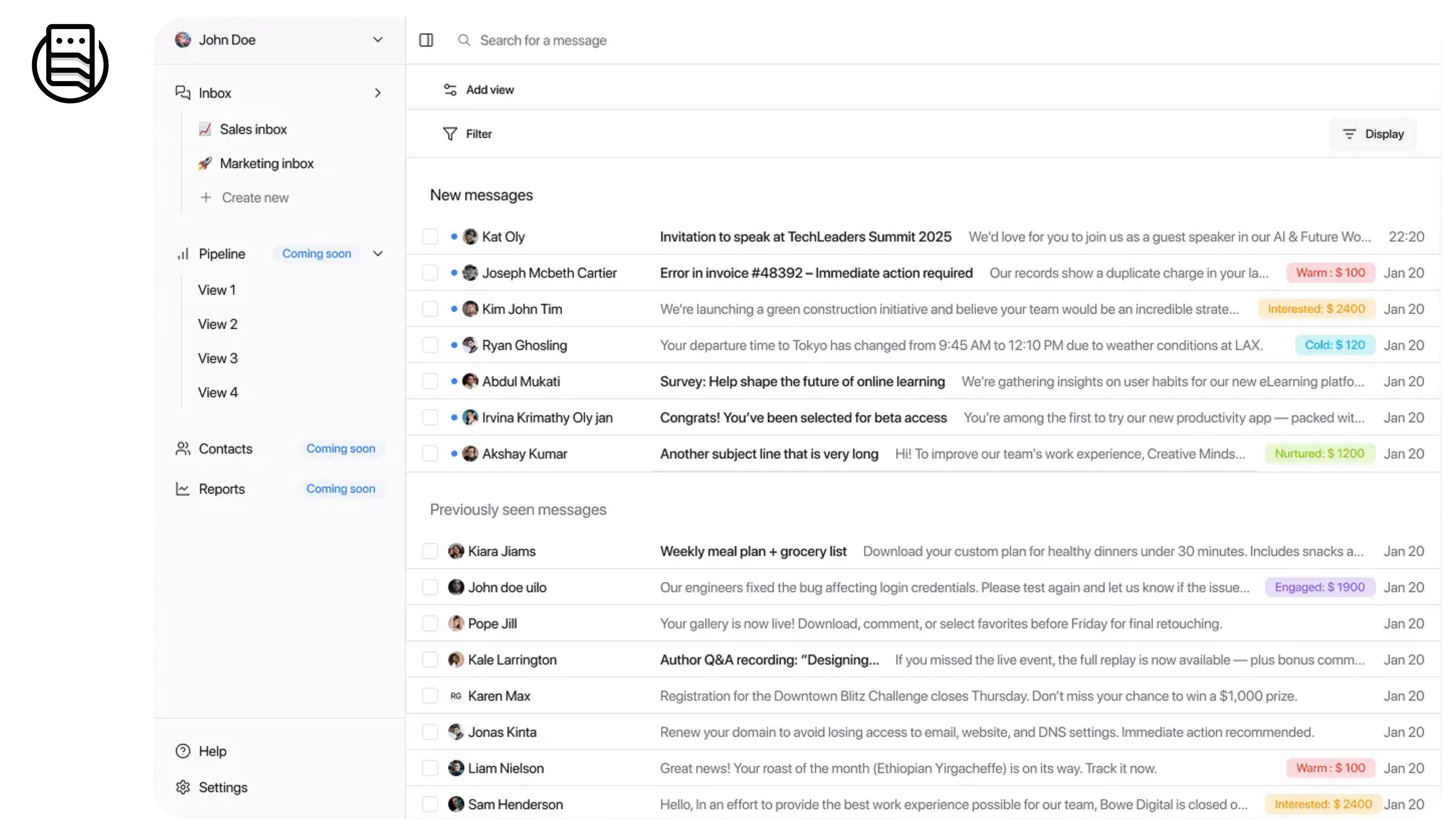
While Front is designed to manage inbound customer service requests, MasterInbox is purpose-built to solve a different, critical problem: managing outbound sales replies. Sales teams send thousands of emails and LinkedIn messages; MasterInbox acts as a filter, using AI to categorize every response (Interested, Not Interested, Unsubscribe, etc.) so reps only focus on warm leads. It’s not about replacing your CRM; it’s about feeding it higher-quality conversations.
Instead of forcing your sales team into another platform, MasterInbox delivers qualified leads right back to their primary inbox, creating a seamless workflow. It centralizes replies from all your favorite sales tools, from Lemlist to HeyReach, into one command center.
Pros
- Unified Sales Inbox: Consolidates replies from all your cold email and LinkedIn outreach tools into one place.
- AI-Powered Categorization: Automatically sorts replies, saving SDRs hours of manual work sifting through out-of-office messages and bounces.
- Streamlined Workflow: Forwards positive replies directly to the assigned rep’s main inbox (e.g., Gmail, Outlook) for immediate action.
- Scalable Pricing: Priced per connected inbox, not per user, making it affordable for growing sales teams.
- Deep Integrations: Natively connects with dozens of popular sales engagement platforms.
Cons
- Not a Help Desk: It is not designed for general customer support, lacking features like ticketing and knowledge bases.
- Outbound Focused: Not suitable for managing inbound channels like website live chat or social media DMs.
- Requires Existing Tools: It works on top of your sales engagement platforms, not as a standalone sending tool.
Pricing approach
Tiered monthly plans based on the number of connected inboxes.
Switching notes from Front
- Adoption is focused on the sales/SDR team, not the entire company.
- MasterInbox complements your CRM and sales stack rather than replacing a core component.
- Replaces the manual process of using forwarding rules or a messy shared inbox for sales replies.
- Setup involves connecting your sending tools, not migrating historical customer support data.
Alternative 2: Help Scout
Best for: Small to medium-sized businesses looking for a simple, intuitive, and customer-friendly help desk.
Why it’s a strong alternative to Front
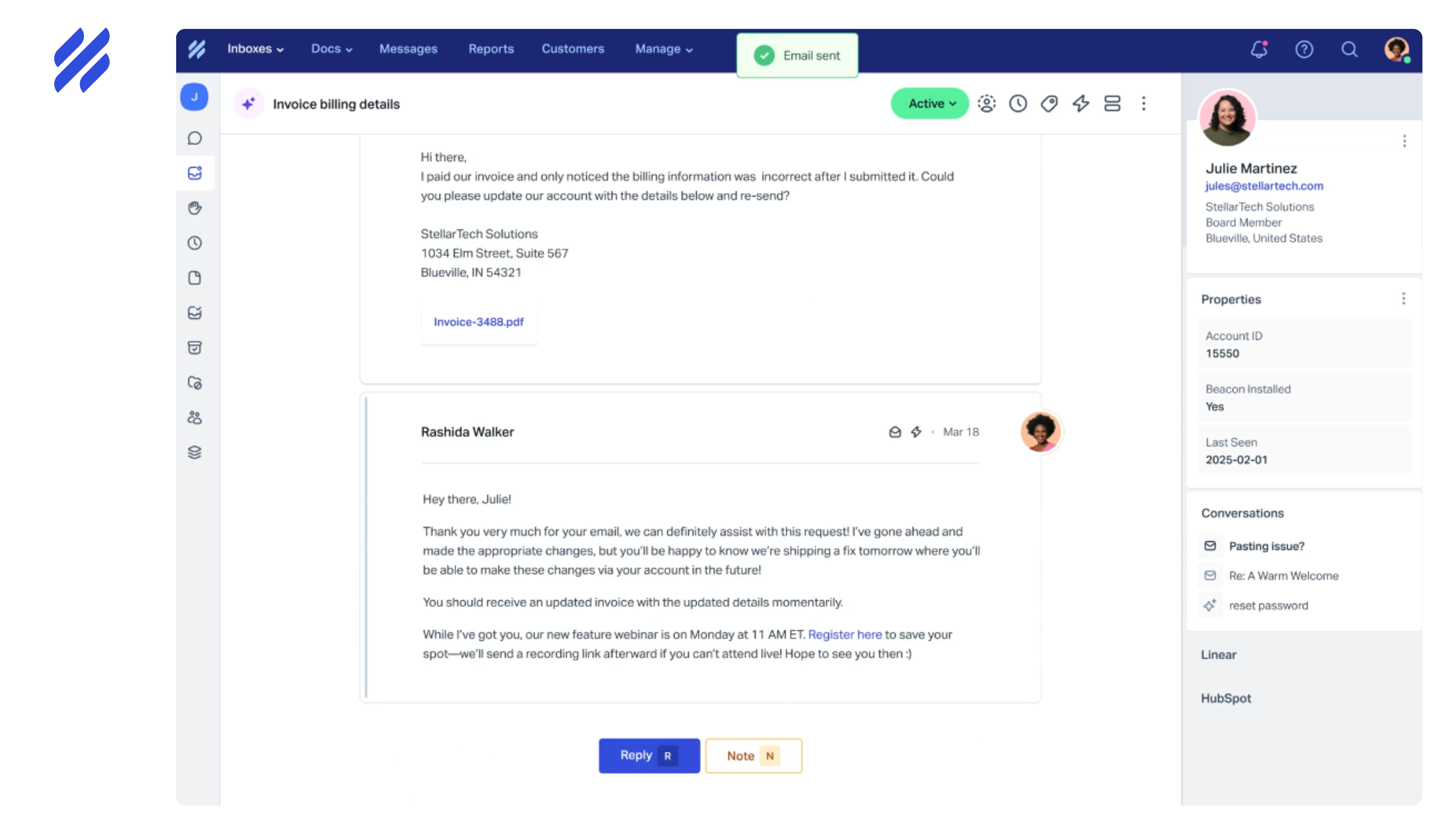
Help Scout is often the first stop for teams who find Front too complex or expensive. It strips the shared inbox concept down to its essentials and executes them beautifully. The platform is built around the idea of delivering human, helpful customer service without the clutter of an enterprise tool. Its interface is clean, collaboration is straightforward, and the focus remains squarely on the customer conversation.
If your team feels bogged down by Front’s extensive features and just wants a great shared inbox, knowledge base, and live chat tool that feels personal, Help Scout is a top contender. It prioritizes ease of use and a gentle learning curve above all else.
Pros
- Exceptional Ease of Use: Widely praised for its clean, intuitive interface.
- Customer-Centric Features: Tools like Beacon (for chat and docs) feel helpful, not intrusive.
- Transparent Pricing: Simple per-user pricing with no hidden fees.
- Strong Knowledge Base: Easy to create and manage a public help center.
Cons
- Fewer Automations: Lacks the complex, multi-step rule-building capabilities of Front or Zendesk.
- Limited Channels: Primarily focused on email and chat; less robust social media or SMS integrations.
- Basic Reporting: Analytics are sufficient for most SMBs but may lack the depth required by larger teams.
Pricing approach
Tiered plans, priced per user, per month.
Switching notes from Front
- Migration is relatively easy due to the focus on core shared inbox functionality.
- Teams can get up and running much faster with minimal training.
- You may need to simplify some of your more complex automation rules.
- The focus shifts from internal process optimization to straightforward customer conversations.
Alternative 3: Intercom
Best for: Businesses focused on proactive customer engagement through live chat, bots, and targeted messaging across the user lifecycle.
Why it’s a strong alternative to Front
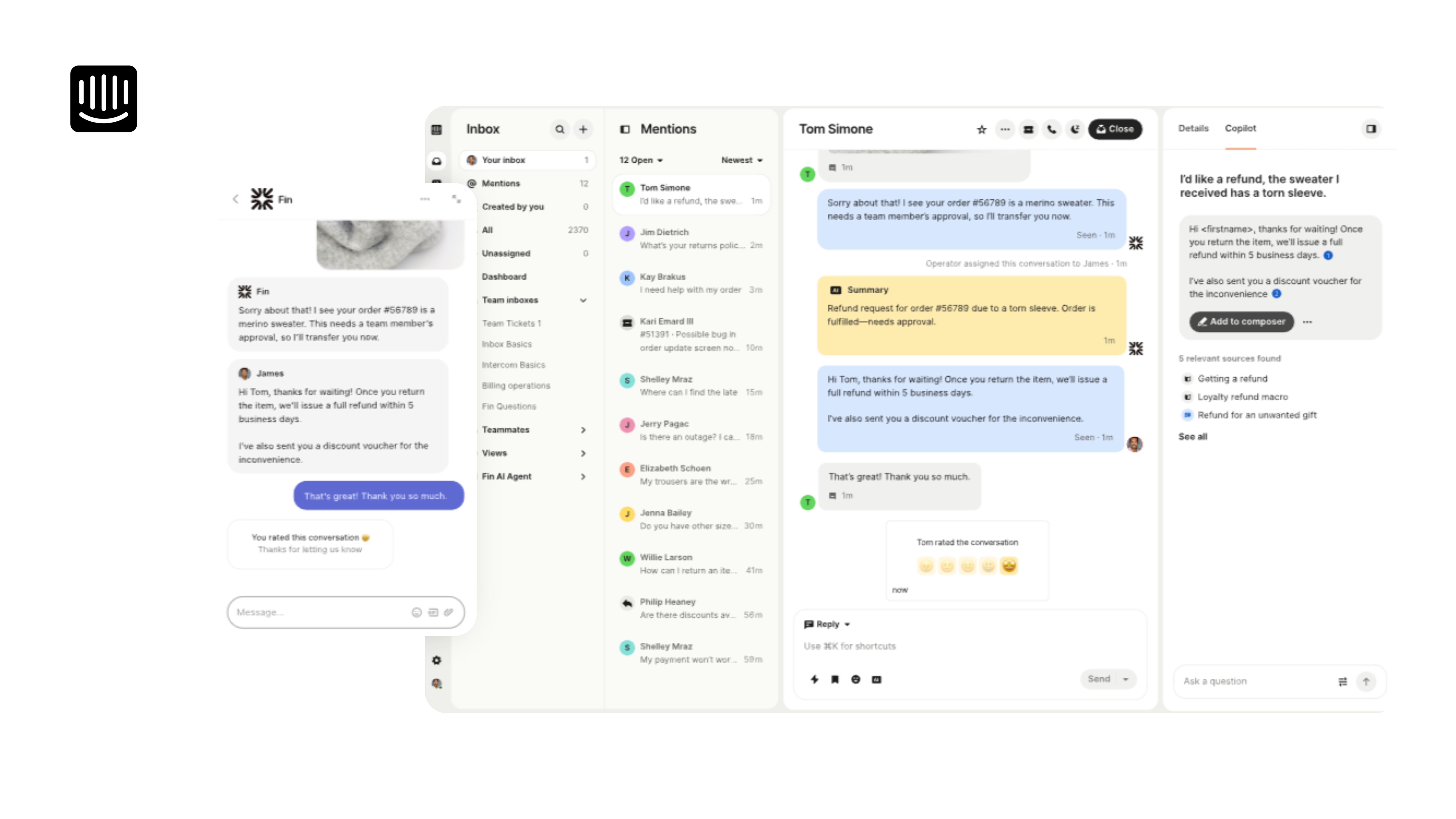
Intercom positions itself as more than a shared inbox; it’s a full-fledged Customer Service Platform. While Front is excellent for reacting to and managing inbound requests, Intercom excels at proactively engaging users with targeted messages, product tours, and sophisticated chatbots. It’s the choice for teams that want to blend support, marketing, and sales into one continuous conversation, primarily through a chat widget on their site.
If your main goal is to drive engagement, convert website visitors, and onboard new users, Intercom’s toolset is more specialized for the job than Front’s. It’s a fundamentally different approach, moving from a reactive support model to a proactive engagement one.
Pros
- Best-in-Class Chatbots: Powerful and customizable bots (Fin AI) for support and sales qualification.
- Proactive Engagement Tools: Excellent for product tours, targeted pop-ups, and marketing campaigns.
- All-in-One Platform: Combines a team inbox, help center, and outbound messaging in one package.
- Sleek User Experience: Both the operator and end-user interfaces are modern and well-designed.
Cons
- Expensive: Pricing can be complex and significantly higher than Front, especially with add-ons and usage-based components.
- Chat-First Focus: The email management capabilities are less robust than dedicated shared inbox tools.
- Can Be Intrusive: If not configured carefully, the proactive messaging can feel spammy to end-users.
Pricing approach
Tiered plans priced per seat, with some plans including usage-based pricing for interactions or contacts.
Switching notes from Front
- This is a strategic shift from an inbox-centric to a chat-centric support model.
- Requires significant setup to configure bots, product tours, and targeted messages.
- Data migration can be complex, as Intercom’s data model is built around users, not just conversations.
- Expect a higher price point but with a different set of capabilities focused on growth.
Alternative 4: Zendesk
Best for: Enterprise companies or rapidly scaling teams that need a powerful, customizable, and feature-rich customer service platform.
Why it’s a strong alternative to Front
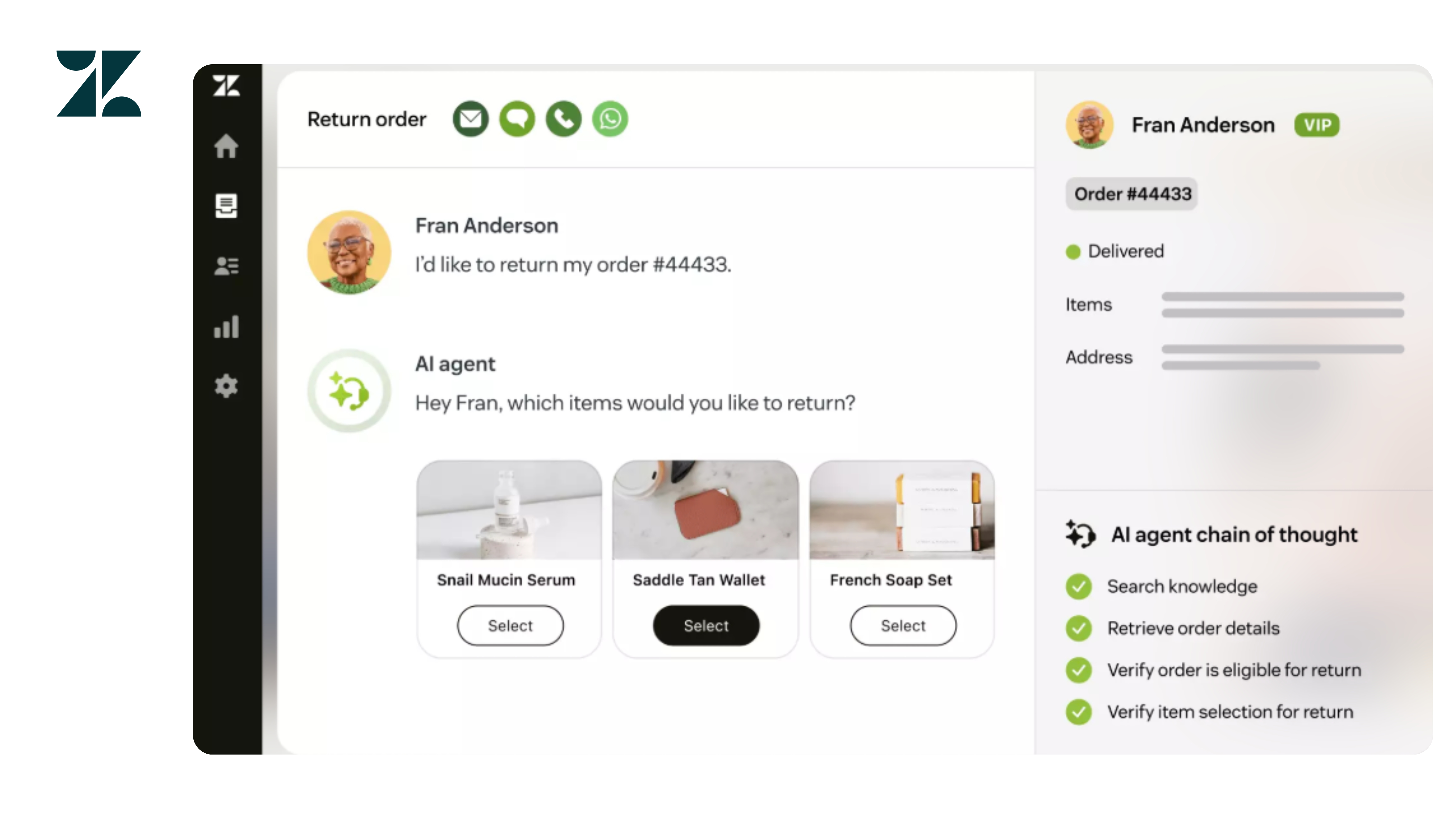
Zendesk is the 800-pound gorilla in the customer service space. It offers a comprehensive suite of tools that goes far beyond a shared inbox, including advanced ticketing, a powerful help center, voice/telephony, and deep analytics. For companies where the support function is a large, complex department with specific SLAs and multi-layered workflows, Zendesk provides the power and customizability that Front may lack.
Choosing Zendesk over Front is a move toward a more structured, enterprise-grade solution. It’s built to handle immense volume and complexity, offering granular control over every aspect of the support process. If you’re outgrowing Front’s capabilities and need a platform that can scale with a global, multi-departmental organization, Zendesk is the industry standard.
Pros
- Unmatched Feature Depth: The most comprehensive feature set on the market for customer support.
- Highly Scalable: Built to handle the needs of the world’s largest companies.
- Extensive Integrations: A massive marketplace with thousands of apps and integrations.
- Powerful Reporting: Granular, customizable analytics for measuring every aspect of support performance.
Cons
- Complex and Overwhelming: The platform has a steep learning curve and can be difficult to configure.
- Expensive: Can be one of the most expensive options, especially for the full suite.
- Impersonal Feel: Can feel more like a corporate ticketing system than a personal communication tool.
Pricing approach
Multiple products and suites with tiered, per-agent pricing.
Switching notes from Front
- This is a major project, not a simple tool swap. It requires significant planning and implementation resources.
- You will likely need a dedicated Zendesk administrator to manage the platform.
- Data migration is complex and often requires third-party tools or developer assistance.
- The workflow will shift from a collaborative inbox model to a more structured ticketing system.
Alternative 5: Missive
Best for: Highly collaborative teams that want to blend internal chat, task management, and external email into a single application.
Why it’s a strong alternative to Front
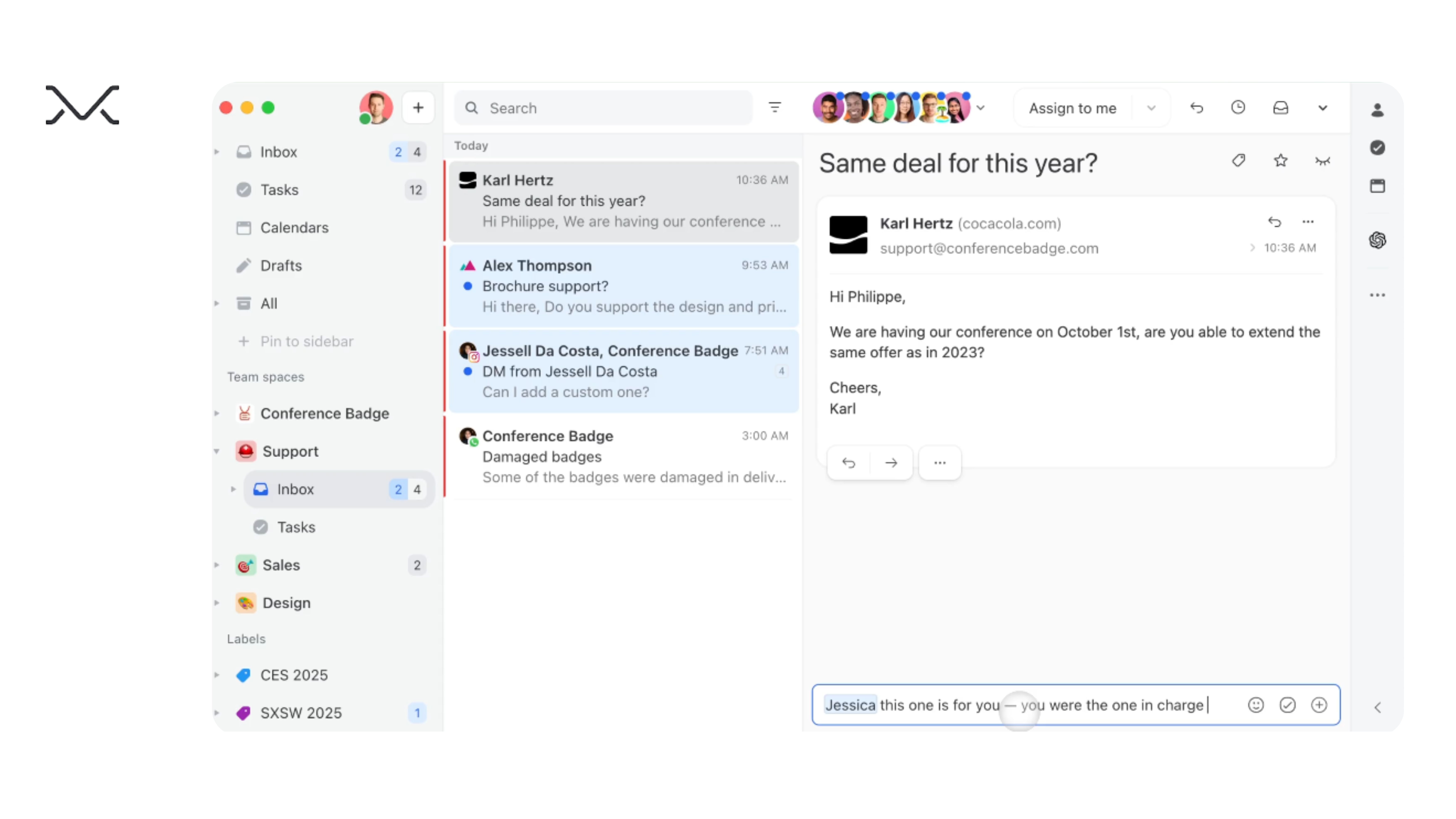
Missive takes the collaborative aspect of Front and dials it up to eleven. It’s designed for teams who want to discuss everything—emails, projects, ideas—in one place. Its standout feature is the ability to have a chat conversation directly within an email thread, effectively merging the functionality of Slack and a shared inbox. This makes it a strong contender for teams who find themselves constantly switching between their email client and a chat app.
Compared to Front, Missive puts a heavier emphasis on internal productivity and project management. If your primary pain point is not just managing customer emails but reducing internal context-switching, Missive’s unique blend of communication and task management is a compelling reason to switch.
Pros
- Excellent Collaboration: Best-in-class features for internal chat, comments, and task assignments within email threads.
- Multi-Channel Support: Integrates with email, SMS, WhatsApp, and social media.
- Generous Free Plan: Offers a free plan for small teams, which is rare in this category.
- Customizable Interface: Users have a high degree of control over the layout and notifications.
Cons
- Can Be ‘Noisy’: The all-in-one approach can lead to a busy interface and notification fatigue.
- Fewer Help Desk Features: Lacks some of the dedicated support features of Front, like advanced SLA rules.
- Learning Curve: The unique workflow of blending chat and email can take some getting used to.
Pricing approach
Free plan available. Paid plans are tiered and priced per user.
Switching notes from Front
- The switch is ideal for teams looking for deeper internal collaboration, not just customer-facing communication.
- Team adoption requires embracing the chat-within-email workflow.
- You can consolidate tools, potentially replacing both a shared inbox and an internal chat app.
- The UI is more customizable but may require more initial setup per user to get right.
Alternative 6: Gorgias
Best for: E-commerce businesses, especially those running on Shopify, Magento, or BigCommerce.
Why it’s a strong alternative to Front
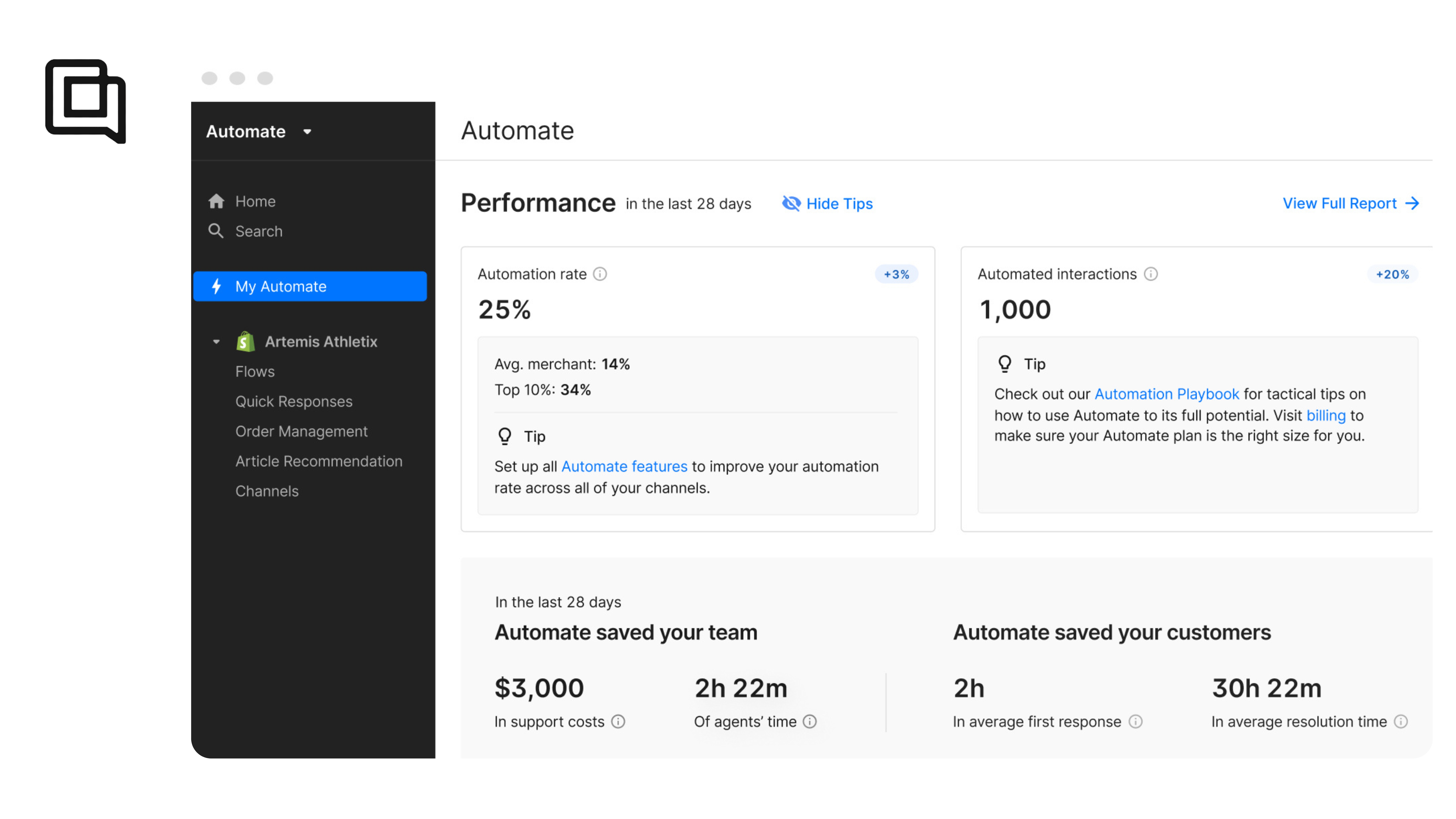
Gorgias is a help desk built from the ground up for e-commerce. While Front is a general-purpose tool, Gorgias offers incredibly deep integrations with platforms like Shopify. This allows support agents to see customer order history, shipping status, and other e-commerce data directly alongside a support ticket. They can even perform actions like issuing refunds or editing orders without leaving the help desk.
For an e-commerce brand, this level of integration is a game-changer. It dramatically speeds up response times and empowers agents to solve problems in one touch. If you run an online store and your support team is constantly switching between Front and your e-commerce backend, Gorgias offers a far more streamlined and efficient workflow.
Pros
- Deep E-commerce Integration: Unparalleled connection with Shopify, Magento, and BigCommerce.
- Revenue-Driving Features: Can track revenue generated by support interactions.
- Automated Responses: Use macros and rules to automate answers to common questions like “Where is my order?”.
- Social Media Integration: Strong tools for managing comments and DMs on Facebook and Instagram ads.
Cons
- Highly Niche: Not a good fit for non-e-commerce businesses like B2B SaaS.
- Ticket-Based Pricing: Pricing is based on ticket volume, which can be unpredictable and expensive for high-volume stores.
- Less General Collaboration: Features are heavily skewed towards e-commerce support tasks.
Pricing approach
Tiered plans based on the number of monthly tickets.
Switching notes from Front
- The switch is a clear win if you are an e-commerce company.
- Setup involves connecting your e-commerce platform, which immediately populates customer data.
- Your team’s workflow will become much more efficient for store-related queries.
- You need to estimate your ticket volume to choose the right plan and budget accordingly.
Alternative 7: Hiver
Best for: Teams that are heavily invested in the Google Workspace ecosystem and want to manage shared inboxes without leaving Gmail.
Why it’s a strong alternative to Front
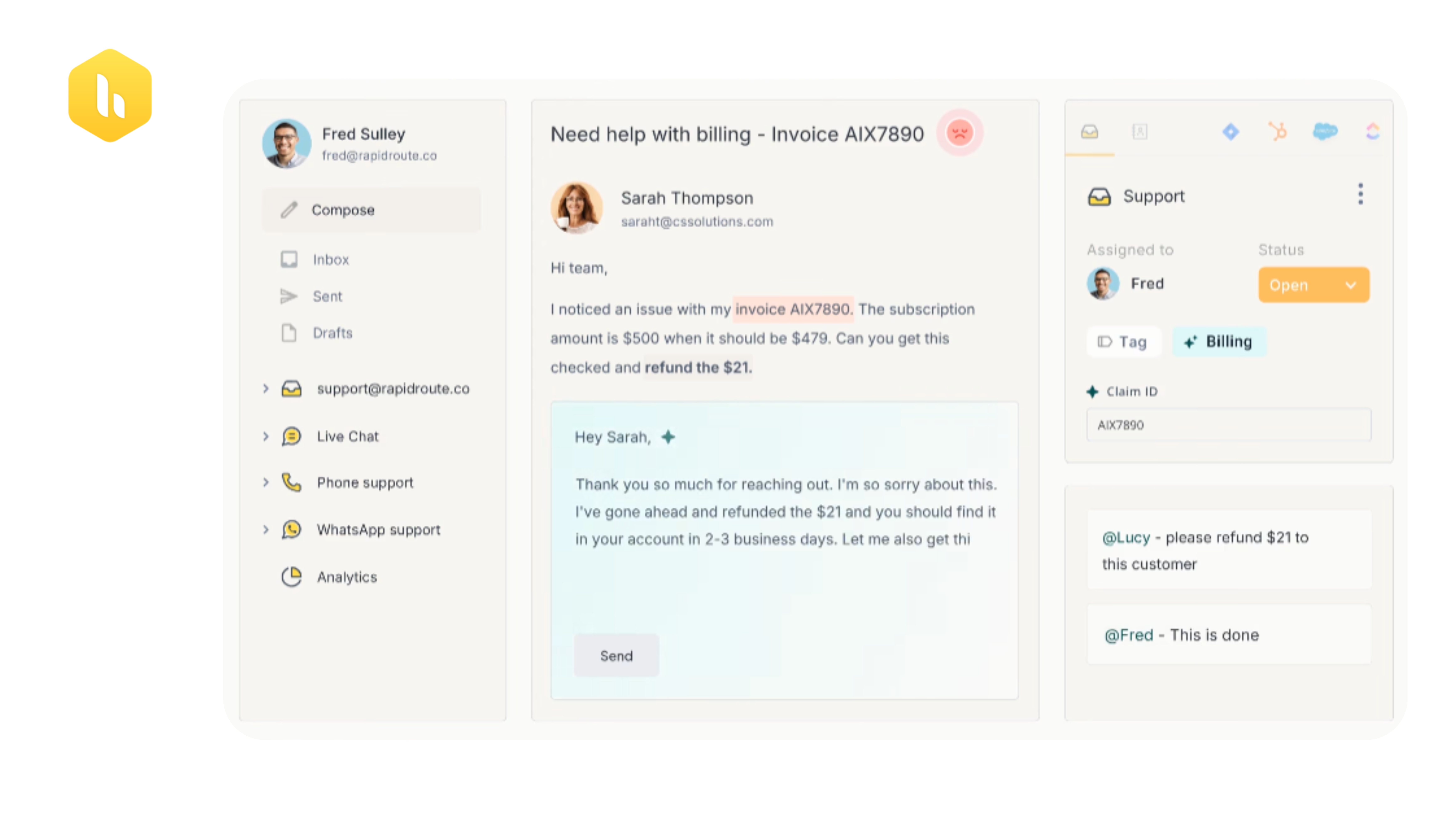
Hiver’s core value proposition is its native integration with Gmail. It doesn’t ask your team to learn a new application; instead, it transforms your existing Gmail interface into a powerful help desk. Shared inboxes appear as folders in the Gmail sidebar, and features like assignments, collision alerts, and analytics are seamlessly woven into the familiar Google environment.
This is a massive advantage for teams resistant to change. If your company runs on Google Workspace and the biggest hurdle to adopting a tool like Front is getting people to leave their inbox, Hiver removes that barrier entirely. It offers much of the same core functionality as Front but with zero learning curve for the UI.
Pros
- Lives Inside Gmail: No new software to learn; leverages your team’s existing knowledge.
- Easy to Set Up: Can be up and running in minutes.
- Robust Feature Set: Includes assignments, collision alerts, analytics, and SLAs within the Gmail UI.
- No App Switching: Reduces context switching and improves productivity for Gmail-heavy users.
Cons
- Google Workspace Only: It is not an option for teams using Microsoft 365 or other email clients.
- Confined by Gmail’s UI: While convenient, it’s also limited by what’s possible within the Gmail interface.
- Fewer Channels: Primarily focused on email, with chat as an add-on; less native support for social or SMS than Front.
Pricing approach
Tiered plans, priced per user, per month.
Switching notes from Front
- The easiest switch in terms of user adoption and training.
- Your team never has to leave their primary inbox.
- Setup is as simple as installing a browser extension and configuring inboxes.
- You lose the standalone, dedicated environment of Front, which some teams may prefer.
Which alternative should you pick?
Choosing the right tool depends entirely on your team’s primary job-to-be-done.
- Choose MasterInbox if… your core challenge is managing and qualifying replies from outbound sales campaigns to find interested leads faster.
- Choose Help Scout if… you need a simple, elegant shared inbox for customer support and value ease of use over feature quantity.
- Choose Intercom if… your strategy is built around proactive engagement, live chat, and converting website visitors.
- Choose Zendesk if… you are an enterprise with complex support needs requiring a powerful, scalable, and highly customizable platform.
- Choose Missive if… your team craves deep collaboration and wants to merge internal chat and project management with email.
- Choose Gorgias if… you run an e-commerce store and need a help desk that integrates deeply with your sales platform.
- Choose Hiver if… your team lives in Gmail and you want to add shared inbox functionality without changing workflows.
Switching Checklist from Front
- Audit Your Usage: Identify which Front features you actually use daily.
- Define Your Goal: Are you trying to save money, improve efficiency, or get more specialized features?
- Shortlist & Trial: Pick your top 2-3 alternatives and run a trial with a small group of users.
- Plan Data Migration: Determine what conversation history and contacts need to be moved.
- Configure Integrations: Set up connections to your CRM, e-commerce platform, or sales tools.
- Rebuild Automations: Re-create your essential rules and workflows in the new tool.
- Train Your Team: Host a session to walk through the new platform and its key workflows.
- Monitor & Optimize: After launch, check analytics and gather feedback to fine-tune your setup. You can even use a reply rate calculator to measure the impact on your outbound efforts.
CTA: Book a demo
FAQs
What are the best Front alternatives?
The best alternatives depend on your needs. For general customer support, Help Scout is a great user-friendly option. For outbound sales teams, MasterInbox is purpose-built for reply management. For e-commerce, Gorgias is the leader, and for large enterprises, Zendesk is the standard.
Is MasterInbox a good alternative to Front?
Yes, but for a very specific use case. MasterInbox is an excellent alternative if you use Front to manage replies from cold outreach. It’s superior for this task due to its AI-powered filtering and integrations with sales platforms. However, it is not a replacement for Front’s inbound customer support features.
What is the most affordable alternative to Front?
Missive offers a generous free plan for very small teams. For paid plans, Help Scout and Hiver often have more accessible entry-level pricing compared to Front’s starter tiers, especially for smaller teams.
Is there a free alternative to Front?
True free alternatives with team features are rare. Missive has the most functional free plan for up to 3 users. Most other professional tools, including Front, offer free trials but require a paid subscription for ongoing team use.
How does Front compare to Zendesk?
Front is generally seen as a more modern, collaboration-focused shared inbox, popular with SMBs and tech companies. Zendesk is an enterprise-grade ticketing system with far greater depth, complexity, and power, designed for large, structured support departments.
Why do people look for Front alternatives?
Common reasons include Front’s per-user pricing becoming too expensive as a team grows, the platform feeling too complex for simple needs, or the need for a more specialized tool for a specific function like outbound sales (MasterInbox) or e-commerce support (Gorgias).
Final recommendation
For most teams looking for a direct replacement for Front’s core shared inbox functionality, Help Scout offers a refreshingly simple and effective solution. It’s a fantastic starting point for any SMB focused on delivering great customer support.
However, if your search for a Front alternative is driven by the chaos of managing outbound sales campaigns, then you’re solving the wrong problem with a general-purpose tool. The best choice is a specialized platform. MasterInbox is designed exclusively to tame your outbound reply inbox, using AI to surface the leads that matter and helping your sales team book more meetings. It’s the missing link in the modern outbound stack.
CTA: Book a demo
Table Of Contents
Author’s Details

Abdul Mukati