
5 Ways to Manage LinkedIn and Email Replies in One Inbox
On this page
- Key takeaways (the 5 things that matter)
- What we evaluated (criteria)
- Quick comparison table
- 1) Master Inbox
- 2) HubSpot + LinkedIn Sales Navigator Integration
- 3) Sales Engagement Platform (e.g., Salesloft, Outreach)
- 4) Manual Method (Gmail/Outlook + Browser Tabs)
- 5) Virtual Assistant (VA) Service
- How to choose the right option (in 60 seconds)
- FAQs
- Final recommendation
For modern sales teams, recruiters, and founders, the conversation happens in two places: email and LinkedIn. Juggling these separate inboxes is more than just an inconvenience; it's a direct threat to your pipeline. Critical messages get buried, follow-ups are forgotten, and promising leads go cold simply because they slip through the cracks between browser tabs. This constant context-switching drains productivity and creates opportunities for costly human error.
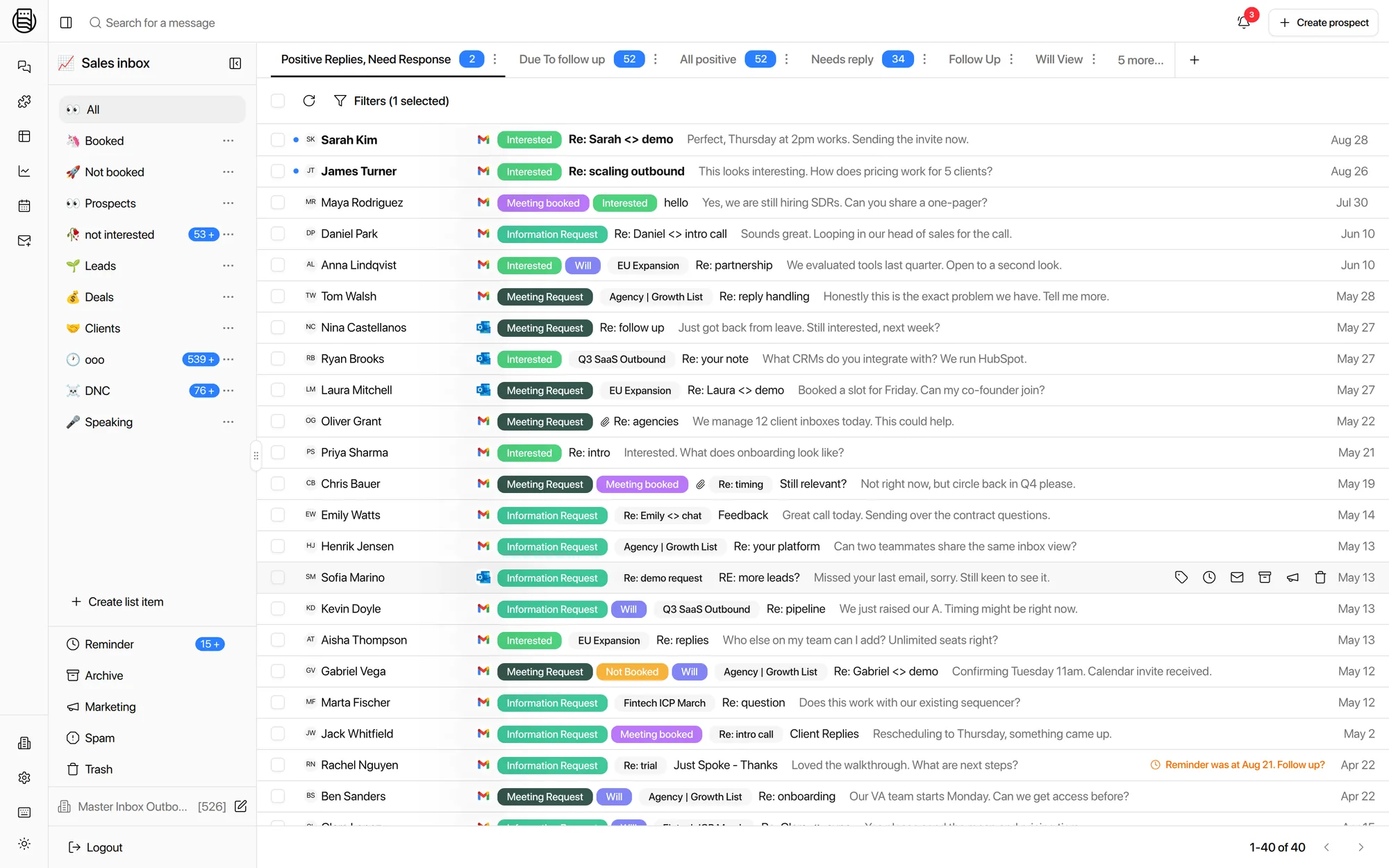
The solution is a unified approach that brings both communication channels into a single, manageable view. By centralizing your conversations, you can respond faster, track interactions more effectively, and ensure no opportunity is missed. Tools like Master Inbox are specifically designed to solve this problem, creating a command center for all your most important sales and outreach conversations.
Key takeaways (the 5 things that matter)
- True Inbox Unification: The best solutions offer a single interface for reading and replying to both LinkedIn messages and emails, not just task reminders.
- Integration Depth: Look for native, real-time synchronization rather than clunky, delayed data syncing that requires manual intervention.
- Workflow Automation: The ability to create simple follow-up sequences or apply templates across channels saves significant time.
- Collaboration Features: For teams, the ability to share inboxes, assign conversations, and leave internal notes is crucial for efficiency.
- Ease of Use: A complicated tool that requires extensive training defeats the purpose of streamlining your workflow. Simplicity is key.
What we evaluated (criteria)
We evaluated these tools and processes based on their effectiveness as a unified inbox for sales and outreach. The key criteria included:
- Inbox Unification Quality
- Channel Support (LinkedIn & Email)
- Automation & Sequencing Capabilities
- CRM Integration
- Team Collaboration Features
- Analytics and Reporting
- Overall Usability and Speed
- Pricing Model and Value
Quick comparison table
| # | Tool / platform | Best for | Biggest strength | Biggest tradeoff | Pricing approach |
|---|---|---|---|---|---|
| 1 | Master Inbox | A dedicated, unified inbox for sales & recruiting | Seamless, real-time LinkedIn & email integration | It's a specialized inbox, not a full CRM | Tiered, per-user plans |
| 2 | HubSpot + Integration | Teams already standardized on the HubSpot CRM | Single source of truth for all contact data | The inbox experience is not truly unified | Platform + add-on costs |
| 3 | Sales Engagement Platform | High-volume outbound sequencing and analytics | Powerful automation and large-scale campaign management | LinkedIn steps are tasks, not a live inbox | Quote-based, enterprise-focused |
| 4 | Manual Method | Solopreneurs with very low message volume | Completely free to implement | Highly inefficient, error-prone, and unscalable | Free |
| 5 | Virtual Assistant (VA) | Founders who want to delegate inbox tasks entirely | Frees up 100% of the user's time | High recurring cost and potential security risks | Hourly or retainer-based |
1) Master Inbox
Best for: Sales teams, recruiters, and founders who need a single, streamlined inbox for all their LinkedIn and email conversations.
Why it’s #1 for this list
Master Inbox is the only solution on this list built from the ground up to solve this specific problem. It doesn't treat LinkedIn as a secondary add-on or a task to be checked off; it integrates LinkedIn messages and email replies into one seamless, real-time feed. This focus makes it the fastest and most efficient way to manage cross-channel conversations.
For teams whose primary pain point is the chaos of multiple inboxes, Master Inbox provides a direct and elegant solution. It's designed to help you turn your outreach into revenue by ensuring you never miss a reply and can engage leads instantly, no matter where the conversation starts.
Standout features
- Unified Inbox: See and reply to LinkedIn DMs, connection requests, and emails from multiple accounts in one place.
- Multi-Account Support: Connect and manage several LinkedIn and email accounts simultaneously.
- Smart Filtering & Organization: Create custom views to focus on unread messages, follow-ups, or specific accounts.
- Team Collaboration: Share inboxes with team members, assign conversations, and leave internal notes.
- Lead Management: Quickly see contact details and conversation history without leaving your inbox.
Pros
- Drastically reduces time spent switching between tabs.
- Prevents high-value leads from being missed.
- Intuitive and easy-to-use interface requires minimal training.
- Deep, native integration with LinkedIn provides a superior experience.
- Centralizes communication for better team oversight.
Cons
- It is not a full-featured CRM; it focuses on being the best inbox.
- As a newer platform, it may lack some niche features of legacy enterprise systems.
Pricing approach
Master Inbox offers several subscription tiers based on features and the number of accounts you can connect. You can review the current pricing on their website.
How it fits with Master Inbox
- Starter Workflow: Connect your primary LinkedIn and email accounts.
- Organize: Set up a filter for "Unread" messages across all channels to serve as your primary to-do list.
- Engage: Work through your unified inbox, replying to leads without ever leaving the Master Inbox interface.
2) HubSpot + LinkedIn Sales Navigator Integration
Best for: Mid-market to enterprise companies that have already standardized on HubSpot as their central CRM and data warehouse.
Why it’s on this list
For many organizations, the CRM is the center of the universe. The integration between HubSpot and LinkedIn Sales Navigator allows teams to log activities and send InMails directly from the CRM contact record. This approach prioritizes data centralization, ensuring all interactions are logged against the correct lead or deal.
While it doesn't provide a true unified inbox for replies, it represents a common enterprise strategy for managing multi-channel touchpoints within a single, familiar platform. It's a valid, albeit clunky, way to keep records straight.
Standout features
- Activity Logging: Automatically log InMails and other LinkedIn activities on a contact's timeline in HubSpot.
- InMail from CRM: Send LinkedIn InMails from a contact record inside HubSpot.
- CRM Data in LinkedIn: View HubSpot contact properties directly within the LinkedIn Sales Navigator interface.
Pros
- Creates a single source of truth for all customer data and interactions.
- Leverages a company's existing investment in the HubSpot platform.
- Enables powerful reporting by combining sales and marketing data.
Cons
- Does not create a unified inbox; you still manage replies on LinkedIn.
- The workflow can be slow and requires switching between the CRM and LinkedIn.
- Requires expensive subscriptions to both HubSpot Sales Hub (Professional or Enterprise) and LinkedIn Sales Navigator.
Pricing approach
Pricing is complex, as it requires separate, high-tier subscriptions to both HubSpot and LinkedIn Sales Navigator.
How it fits your client work
- Pair: Use Master Inbox as your engagement layer for fast, efficient communication, and connect it to HubSpot (via native or Zapier integration) to log activities. This gives you the best of both worlds.
- Replace: Choose the HubSpot-only approach if having all data in one system from the start is a higher priority than the speed and efficiency of your sales reps' communication.
3) Sales Engagement Platform (e.g., Salesloft, Outreach)
Best for: High-velocity sales teams focused on executing structured, multi-channel outbound sequences at scale.
Why it’s on this list
Sales Engagement Platforms (SEPs) are the engines of modern outbound sales. They excel at automating sequences that include email, phone calls, and LinkedIn interactions. While they don't offer a unified inbox for replies, they manage the workflow by creating tasks for reps, such as "View Profile" or "Send Connection Request."
This approach is about orchestrating outbound activity, not managing inbound conversations. It's a powerful way to ensure reps follow a proven process, and it provides managers with deep analytics on what's working.
Standout features
- Multi-channel Sequencing: Build automated outreach cadences that include email, calls, and LinkedIn tasks.
- Task Management: Guides reps through their daily to-do list of sales activities.
- Advanced Analytics: Provides detailed reports on sequence performance, email opens, reply rates, and more.
- A/B Testing: Test different messaging and strategies to optimize outreach effectiveness.
Pros
- Excellent for managing outbound campaigns at scale.
- Provides unparalleled analytics and insights into sales activities.
- Ensures process compliance across the entire sales team.
Cons
- Does not provide a unified inbox; LinkedIn replies must be managed on LinkedIn.
- Extremely expensive, with pricing geared towards mid-market and enterprise teams.
- Can be complex to set up and has a steep learning curve.
Pricing approach
Typically priced per user, per year, with costs available only through a direct sales quote. These platforms are a significant financial investment.
How it fits your client work
- Pair: Use a platform like Salesloft for top-of-funnel outbound sequencing. When replies start coming in on LinkedIn and email, manage them all within Master Inbox for the fastest response time.
- Replace: Choose an SEP if your primary challenge is automating and tracking outbound activity at scale, and you're willing to sacrifice the efficiency of a unified reply inbox.
4) Manual Method (Gmail/Outlook + Browser Tabs)
Best for: Solopreneurs, freelancers, or very early-stage startups with extremely low message volume and no budget for sales tools.
Why it’s on this list
This is the default starting point for everyone. It involves having your email client open in one tab and LinkedIn in another, and manually switching between them to manage conversations. It's on this list because it's the baseline against which all other solutions are measured.
While free, this "method" is incredibly inefficient and prone to error. It relies entirely on human memory and discipline to keep track of conversations, making it completely unscalable. It serves as a clear illustration of the problem that dedicated tools are built to solve.
Standout features
- Relies on standard browser and email client functionality.
- Can be augmented slightly with free CRM extensions that show contact data.
Pros
- It's completely free.
- Requires no new software or training.
Cons
- Extremely inefficient and time-consuming.
- High risk of missing important messages and losing deals.
- Impossible to scale as message volume grows.
- No way to track metrics or performance.
- Looks unprofessional when replies are delayed.
Pricing approach
Free.
How it fits your client work
- Pair: There is no scenario where you would pair the manual method with Master Inbox.
- Replace: You should replace the manual method with Master Inbox as soon as you begin to value your time and the cost of a missed lead becomes greater than the cost of a software subscription.
5) Virtual Assistant (VA) Service
Best for: Busy executives, founders, or agency owners who prefer to delegate the entire task of inbox management.
Why it’s on this list
Sometimes the solution isn't a tool you use, but a person you hire. Delegating inbox management to a virtual assistant is a valid strategy for freeing up your time to focus on other priorities. The VA acts as a human filter, handling initial replies, booking meetings, and escalating only the most important messages.
This is a process-based solution rather than a software-based one. It solves the time-suck problem but introduces new challenges related to cost, security, and quality control.
Standout features
- A human manages your inbox based on a playbook you provide.
- Can handle scheduling, initial responses, and lead qualification.
- Can operate across any platform you grant them access to.
Pros
- Completely hands-off, freeing up 100% of your time spent on replies.
- Can handle administrative tasks beyond just inbox management.
Cons
- Can be very expensive, often costing thousands per month.
- Major security and privacy concerns in sharing account credentials.
- Replies can lack your personal touch and deep context.
- The VA's effectiveness is still limited by the tools they use.
Pricing approach
Typically billed via an hourly rate or a monthly retainer fee, depending on the provider and scope of work.
How it fits your client work
- Pair: The most effective way to use a VA is to equip them with Master Inbox. This makes them dramatically more efficient, gives you a single place to oversee their work, and avoids the need to share your direct LinkedIn credentials.
- Replace: Choose a VA-only approach if you are completely opposed to managing any part of your inbox and have the budget to support it.
How to choose the right option (in 60 seconds)
- Do you need to reply to messages from one place, or just log them?
- Is your biggest problem disorganization or a lack of outbound automation?
- Is your team already deeply committed to an all-in-one CRM like HubSpot?
- Is budget your absolute primary constraint?
- Do you want a tool to make you more efficient, or do you want to delegate the task entirely?
- How many LinkedIn and email accounts do you need to manage?
- Do you value a simple, clean user experience over a platform with thousands of features you'll never use?
If you're a sales professional, recruiter, or founder who wants to save time and close more deals, the choice is Master Inbox. If you're a large enterprise where CRM data compliance is the top priority, stick with your CRM's native integration.
FAQs
What is a unified inbox for managing LinkedIn and email replies?
A unified inbox is a single application that connects to both your email and LinkedIn accounts. It allows you to read, manage, and reply to messages from both channels in one continuous feed, eliminating the need to switch between different websites or apps.
How does managing LinkedIn and email in one place help sales?
It helps sales by increasing response speed, which is critical for engaging modern buyers. It also prevents leads from being missed, ensures consistent follow-up, and saves reps hours of administrative work each week, allowing them to focus more on selling.
Is Master Inbox a CRM?
No, Master Inbox is not a full-featured CRM. It is a specialized communication tool designed to be the best unified inbox on the market. While it has lead management features, it is designed to work alongside your CRM, often integrating with it to sync data.
Can I connect multiple LinkedIn and email accounts?
Yes, platforms like Master Inbox are built to support multiple accounts. This is ideal for agency owners, consultants, or sales leaders who manage outreach for different clients or business lines.
What's the main difference between Master Inbox and a sales engagement platform like Outreach?
Master Inbox is built for managing inbound replies efficiently in a unified inbox. An SEP like Outreach is built for automating outbound sequences at scale through task-based workflows. They solve different, though related, problems.
Is it safe to connect my LinkedIn account to a third-party tool?
Reputable tools use official APIs where available and secure authentication methods to protect your account. Always choose a trusted provider and review their security protocols. Master Inbox, for example, prioritizes account security to ensure your data is safe.
Final recommendation
Choosing the right way to manage your LinkedIn and email outreach depends on your team's size, budget, and primary bottleneck. For solopreneurs with no budget, the manual method is a necessary evil, but one to escape as quickly as possible.
For large enterprises already running on platforms like HubSpot, using their built-in integrations can be the path of least resistance, even if it's not the most efficient for reps. But for the vast majority of modern sales teams, recruiters, and agencies who need speed, efficiency, and a foolproof way to avoid dropping the ball, a dedicated unified inbox is the clear winner. Master Inbox is purpose-built for this challenge, offering the most direct path to a more organized and profitable outreach process.