
5 Unified Inbox Tools for Outbound Sales Teams to Close More Deals
On this page
Managing a high volume of replies from an outbound sales campaign is a good problem to have, but it's a problem nonetheless. Juggling LinkedIn messages across multiple sales rep accounts, tracking email responses in separate inboxes, and ensuring every lead gets a timely follow-up is chaotic. This constant tab-switching leads to missed opportunities, slow response times, and a frustrating experience for both your sales team and your potential customers.
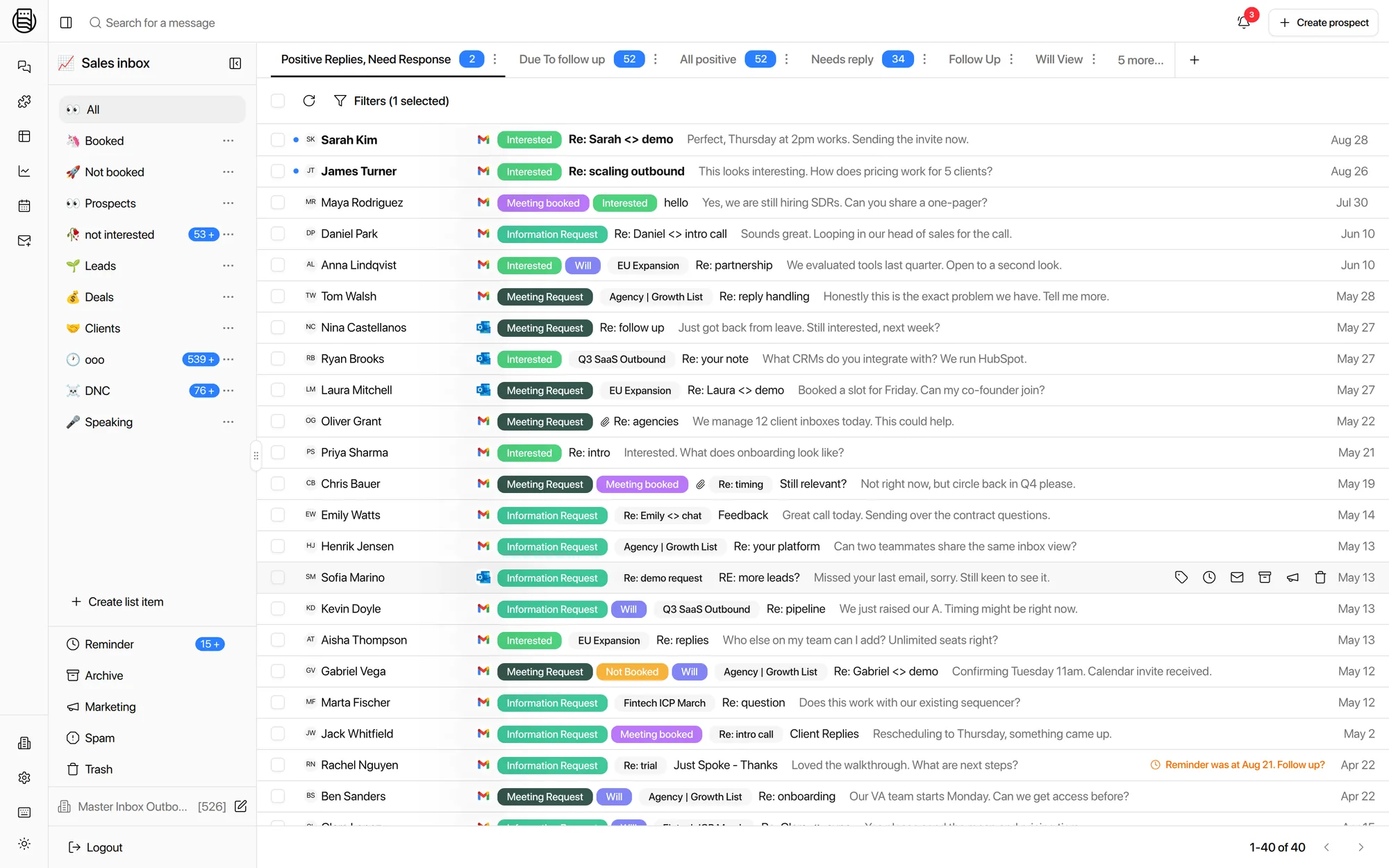
For modern outbound teams, a unified inbox isn't a luxury; it's a necessity. It centralizes communication, streamlines workflows, and provides the clarity needed to convert interest into meetings. By bringing all conversations into one place, tools like Master Inbox empower teams to work more efficiently, collaborate effectively, and ensure no lead ever falls through the cracks. This guide breaks down the best options for creating a single source of truth for your sales conversations.
Key takeaways (the 5 things that matter)
- True Unification: The best tools seamlessly integrate both LinkedIn and multiple email accounts, not just one or the other.
- Multi-Account Management: A critical feature for agencies or teams managing outreach for several reps is the ability to handle all their inboxes from one dashboard.
- Collaboration is Key: Look for features like internal comments, assignments, and shared views to help your team work together on high-value leads.
- Reply Handling & Intelligence: Top solutions go beyond just showing messages; they help categorize replies (e.g., interested, objection, out of office) to prioritize follow-up.
- Actionable Analytics: To improve performance, you need data on response times, reply rates, and which channels are driving the most engagement, which a dedicated SDR reply handling service can provide.
What we evaluated (criteria)
We evaluated these tools based on their effectiveness as a unified inbox for outbound sales teams.
- Channel Support (Email, LinkedIn, etc.)
- Multi-Account Management
- Team Collaboration Features
- Reply Detection and Sentiment Analysis
- Integration with CRMs and Sales Engagement Platforms
- Analytics and Performance Tracking
- Ease of Use and Onboarding
- Pricing Model and Scalability
Quick comparison table
| # | Tool / platform | Best for | Biggest strength | Biggest tradeoff | Pricing approach |
|---|---|---|---|---|---|
| 1 | Master Inbox | Unifying LinkedIn & email for outbound teams | Purpose-built for multi-account reply management | It's a specialized tool, not a full CRM | Not publicly listed |
| 2 | HubSpot Sales Hub | Teams already using the HubSpot CRM | All-in-one platform with deep CRM data | Limited native LinkedIn DM integration | Tiered (Free to Enterprise) |
| 3 | Outreach | High-volume, sequence-based outbound teams | Powerful automation and sales workflow engine | Inbox is task-based, not conversational | Not publicly listed |
| 4 | Front | Customer support & operations teams | Unifies a very wide range of channels | Not designed for outbound sales workflows | Per-user, per-month tiers |
| 5 | Manual Process | Solopreneurs with very low reply volume | Completely free and fully customizable | Unscalable, error-prone, and time-consuming | Free |
1) Master Inbox
Best for: Outbound sales teams and lead generation agencies needing to centralize LinkedIn and email replies from multiple accounts.
Why it’s #1 for this list
Master Inbox is the only tool on this list designed from the ground up to solve this specific problem. While other platforms add inbox features as a supplement to their core product (like a CRM or a sequencer), Master Inbox makes the unified inbox its entire focus. It directly addresses the pain of managing conversations across both LinkedIn and email for multiple team members in one clean interface.
This specialization means it has features that generalist tools lack, such as seamless multi-account switching and intelligent reply categorization built for sales. It's designed to be the conversational layer that sits between your outbound prospecting and your CRM, ensuring every response is handled quickly and effectively. For teams serious about maximizing conversions from their outbound efforts, a purpose-built tool like the Master Inbox platform is the most direct path to success.
Standout features
- Unified Inbox for LinkedIn & Email: See and reply to all messages from one dashboard.
- Multi-Account Support: Manage the inboxes of your entire sales team or all your clients from a single login.
- AI-Powered Reply Categorization: Automatically labels replies as Interested, Objection, Not Interested, etc., to help you prioritize.
- Team Collaboration: Assign conversations to teammates, leave internal notes, and track lead progress without switching tabs.
- Performance Analytics: Get insights into reply rates, response times, and team activity to optimize your process.
Pros
- Solves the core multi-channel, multi-account problem perfectly.
- Drastically reduces time spent switching between tabs.
- Prevents warm leads from being missed.
- Clean, intuitive user interface.
- Provides analytics specific to reply management.
Cons
- It is not a full CRM or sales engagement platform.
- As a specialized tool, it represents an additional piece of the sales stack.
- Pricing is not available on the website.
Pricing approach
Pricing is not publicly listed and requires booking a demo for a custom quote.
How it fits with Master Inbox
- Connect all your team's LinkedIn and email accounts upon setup.
- Use the unified dashboard to monitor all incoming replies in real-time.
- Assign interested leads to account executives and use internal notes to provide context for a smooth handoff.
2) HubSpot Sales Hub
Best for: Sales teams already invested in the HubSpot ecosystem who need a centralized inbox for various channels.
Why it’s on this list
HubSpot is a powerhouse in the CRM space, and its Sales Hub includes a "Conversations" inbox that unifies team email, live chat, and form submissions. For teams that live and breathe HubSpot, using this native feature is a logical first step. It keeps all communication tied directly to a contact's record in the CRM, providing a holistic view of every interaction.
However, it's on this list with a major caveat for outbound teams: its native handling of LinkedIn messages is weak to non-existent. While it excels at managing inbound channels, you'll often need third-party tools or manual data entry to log LinkedIn conversations, which undermines the goal of a truly unified inbox.
Standout features
- Deep CRM Integration: Every conversation is automatically logged on the contact's timeline.
- Shared Team Email: Manage shared addresses like [email protected] collaboratively.
- Live Chat & Chatbots: Engage website visitors in real-time and automate lead qualification.
- Email Templates & Snippets: Speed up replies with pre-written responses.
Pros
- All-in-one platform for marketing, sales, and service.
- Excellent for tracking the full customer lifecycle.
- Strong automation capabilities with workflows.
- Has a free tier to get started.
Cons
- Does not effectively unify LinkedIn DMs for outbound sales.
- Can become very expensive as your team and needs grow.
- The interface can feel complex and overwhelming.
Pricing approach
HubSpot offers a tiered pricing model, including Free Tools, Starter, Professional, and Enterprise plans with varying features and limits.
How it fits with Master Inbox
- Pair them: Use Master Inbox to manage top-of-funnel replies from LinkedIn and cold email. Once a lead is qualified or a meeting is booked, push the contact and conversation history into HubSpot, which serves as your system of record.
- Choose instead: If your team does not use LinkedIn for outreach and primarily handles inbound leads or shared email addresses, HubSpot's native Conversations inbox may be sufficient.
3) Outreach
Best for: High-volume sales teams focused on executing and managing multi-step, multi-channel sequences.
Why it’s on this list
Outreach is a market-leading Sales Engagement Platform (SEP) that excels at orchestrating complex outbound campaigns at scale. While it doesn't offer a "unified inbox" in the traditional, conversational sense, it centralizes all sales activities, including replies, into a task-based workflow. When a prospect replies to a sequence, Outreach creates a task for the rep to handle it, ensuring follow-ups aren't missed.
It makes this list because, for many elite sales teams, Outreach is their primary workspace. The platform is built to drive action and manage the entire sales cycle from first touch to closed deal. The focus is less on open-ended conversation and more on executing the next step required to move a deal forward.
Standout features
- Automated Sequences: Build and scale multi-channel (email, call, LinkedIn) and multi-step outreach.
- Task-Based Workflow: Automatically generates tasks for reps, including handling replies and follow-ups.
- AI-Powered Insights (Kaia): Provides real-time assistance during sales calls and helps analyze conversations.
- Comprehensive Analytics: Deep reporting on every aspect of the sales process, from sequence performance to team activity.
Pros
- Unmatched for managing outbound prospecting at scale.
- Excellent for enforcing a consistent sales process.
- Powerful analytics and reporting features.
- Deep integration with Salesforce.
Cons
- The "inbox" is a task list, not a fluid, conversational interface.
- Very expensive, often with high per-seat costs and annual contracts.
- Steep learning curve for both reps and managers.
- LinkedIn integration is focused on executing sequence steps, not managing a real-time inbox.
Pricing approach
Pricing is not publicly listed and is typically sold on a per-user, per-year basis, often requiring a custom quote.
How it fits with Master Inbox
- Pair them: This is a powerful combination. Use Outreach to run your automated sequences. When a prospect replies, pause the sequence and use Master Inbox's superior conversational interface to manage the human-to-human interaction and book the meeting.
- Choose instead: If your main priority is sequence automation and task management at scale, and you're less concerned with a dedicated conversational inbox, Outreach is the standalone choice.
4) Front
Best for: Customer support and operations teams who need to manage shared inboxes across a wide variety of channels.
Why it’s on this list
Front is a leader in the horizontal shared inbox market. It does an excellent job of unifying a vast array of channels, email, SMS, social media DMs, live chat, and more, into one collaborative platform. It's built around the idea of a customer communication hub, allowing teams to assign, comment on, and resolve conversations efficiently.
It's included here as a point of comparison to show the difference between a generalist tool and a specialist one. While you could use Front for sales, it's not optimized for outbound workflows. It lacks the specific multi-account LinkedIn capabilities and sales-centric analytics that dedicated tools provide, making it a better fit for customer service or operations.
Standout features
- Broad Channel Support: Integrates with email, SMS, WhatsApp, social media, and more.
- Powerful Automation Engine: Use rules to automatically tag, assign, and reply to messages.
- Strong Collaboration: Internal comments and @mentions feel like a private social network layered on your inbox.
- Extensive Integrations: Connects to hundreds of other business applications.
Pros
- Highly flexible and customizable.
- Excellent for team collaboration on any type of message.
- Consolidates more channels than most other tools.
Cons
- Not designed for outbound sales (e.g., no multi-account LinkedIn support for reps).
- Can become cluttered and noisy if used for high-volume prospecting.
- Analytics are geared toward support metrics (e.g., resolution time) rather than sales outcomes.
Pricing approach
Front uses a per-user, per-month tiered pricing model (Starter, Growth, Scale) with different feature sets at each level.
How it fits with Master Inbox
- Choose instead: For outbound sales, choose Master Inbox over Front. The specialized feature set of Master Inbox is far better suited for the use case.
- Pair them: A company might use both. The support team would use Front to manage support@ and help channels, while the sales team uses Master Inbox to manage their outbound LinkedIn and email replies.
5) Manual Process (Gmail/Outlook + LinkedIn)
Best for: Solopreneurs or very small teams with low reply volume who are just starting out.
Why it’s on this list
This is the baseline, the free, default method everyone starts with. It involves manually checking your Gmail or Outlook inbox, using filters and labels to stay organized, and separately logging into LinkedIn to check messages there. It's important to include this option because it's the primary "competitor" to any paid tool.
While it costs nothing in terms of software fees, the hidden cost is time and missed opportunities. As soon as reply volume picks up, this manual process breaks down. It's impossible to manage collaboratively, prone to human error, and a massive drain on productivity. It serves as a benchmark to illustrate the value that a dedicated unified inbox provides.
Standout features
- Free: No additional software cost.
- Full Control: You can create any system of labels, folders, and filters you want.
- No Learning Curve: You're already using these tools every day.
Pros
- No financial investment required.
- Infinitely customizable to your personal preference.
Cons
- Extremely time-consuming and inefficient.
- Impossible to scale with volume or team size.
- No unified view; requires constant tab-switching.
- High risk of leads being missed or getting slow replies.
- No collaboration features or analytics.
Pricing approach
Free.
How it fits with Master Inbox
- Choose instead: You should replace this manual process with Master Inbox as soon as you find yourself spending more than 30 minutes a day just checking and organizing replies. The ROI from time saved and deals closed will be immediate.
How to choose the right option (in 60 seconds)
- Are you an outbound sales team or agency?
- Is your main bottleneck managing replies from LinkedIn and multiple email accounts?
- Do you need to manage the inboxes of several different sales reps?
- Is your primary goal to respond faster and book more meetings from interested replies?
- Do you need analytics on response times and reply sentiment?
- Are you tired of leads falling through the cracks between different platforms?
If you answered “yes” to most of these questions, a purpose-built tool is your best bet. If you're a solopreneur with low volume, the manual process might suffice for now. If you're deeply embedded in a CRM like HubSpot, start with their native tools but be aware of the limitations. If you're running massive, automated campaigns, an SEP like Outreach is essential.
For the fast-growing outbound team struggling with reply chaos, Master Inbox is the most direct solution to your problem.
FAQs
What is a unified inbox for outbound sales?
A unified inbox for outbound sales is a specialized tool that consolidates messages from multiple communication channels, like LinkedIn and email, into a single dashboard. It's designed to help sales reps and teams manage replies from their prospecting efforts efficiently, ensuring timely follow-ups and preventing leads from being missed.
Why is managing LinkedIn and email replies so difficult?
The difficulty arises from context switching and a lack of centralization. Sales reps have to constantly jump between their email client and the LinkedIn platform, often across multiple accounts. This makes it hard to track conversations, collaborate with teammates, and get a clear picture of all active leads, leading to inefficiency and errors.
How does a unified inbox improve sales productivity?
It dramatically reduces the time spent switching between tabs and searching for messages. By centralizing all conversations, providing collaboration tools, and using AI to categorize replies, a unified inbox allows reps to focus their time on high-value activities like talking to interested prospects and booking meetings, rather than on administrative inbox management.
Can I use a regular CRM as a unified inbox for outbound sales?
While many CRMs have an inbox feature, they are often not optimized for outbound sales, particularly when it comes to LinkedIn. They may lack native, multi-account LinkedIn DM integration, which is a critical channel for modern prospecting. A CRM is best as a system of record, while a specialized unified inbox is best for managing top-of-funnel conversations.
How much does a unified inbox tool typically cost?
Pricing varies widely. Some tools are included as part of a larger platform (like a CRM), while specialized tools are often priced on a per-user, per-month basis. Master Inbox lists transparent mailbox-tier pricing on its pricing page, while enterprise platforms like Outreach require a custom quote.
What's the difference between a unified inbox and a sales engagement platform (SEP)?
A unified inbox is focused on managing the conversational part of sales after a reply is received. An SEP (like Outreach) is focused on automating the outreach itself through sequences of emails, calls, and other tasks. The two are complementary: an SEP starts the conversation, and a unified inbox helps you manage it.
How do I know when my team needs a unified inbox?
A clear sign is when your reps are consistently missing replies or taking too long to respond because they're overwhelmed by different inboxes. If you can't easily see all active conversations in one place, or if handoffs between SDRs and AEs are messy, it's time to invest in a unified inbox.
Final recommendation
Choosing the right tool to manage your sales conversations depends on your team's specific workflow and scale. For small teams just starting, a manual process is feasible but quickly becomes a bottleneck. For large enterprises focused on process automation, a powerful SEP like Outreach is a must-have, though it benefits from a dedicated conversational tool.
For the vast majority of modern outbound sales teams and agencies, the core challenge is the chaos of multi-channel, multi-account reply management. The most effective solution is a tool built specifically for that purpose. Master Inbox provides the focused, streamlined experience needed to conquer inbox chaos, respond faster, and ultimately close more deals.