
5 Methods for Capturing Missed Replies From Cold Outbound
On this page
- Key takeaways (the 5 things that matter)
- What we evaluated (criteria)
- Quick comparison table
- 1) Master Inbox
- 2) Email Client Rules & Filters (Gmail/Outlook)
- 3) CRM Sales Engagement Hub (e.g., HubSpot, Salesforce)
- 4) Manual Auditing / Virtual Assistant (VA)
- 5) Custom Zapier/Make Automations
- How to choose the right option (in 60 seconds)
- FAQs
- Final recommendation
Sending cold outreach at scale is a numbers game, but the real wins happen in the replies. The problem is, when your team sends hundreds or thousands of emails and LinkedIn messages, replies can easily get lost. They hide in cluttered inboxes, get buried under new messages, or are simply overlooked. This leads to lost revenue, frustrated prospects who receive unnecessary follow-ups, and a damaged brand reputation.
For B2B sales teams, SDRs, and outbound agencies, this is a critical operational gap. Manually tracking every conversation across multiple channels and mailboxes is unsustainable and prone to error. This is precisely the challenge platforms like Master Inbox were built to solve, by creating a central nervous system for all your outbound conversations, ensuring no lead is ever left behind.
Key takeaways (the 5 things that matter)
- Centralization is non-negotiable: Managing replies across separate email and LinkedIn inboxes is the primary cause of missed leads.
- Automated follow-up suppression is crucial: Continuing to send follow-ups to someone who has already replied (even negatively) damages your brand's reputation.
- Reply sentiment analysis saves time: Automatically knowing if a reply is positive, negative, or an objection helps your team prioritize who to engage with first.
- Team collaboration ensures speed: The ability to assign conversations to the right team member ensures fast and accurate responses.
- Performance tracking drives improvement: You can't improve what you don't measure. Analytics on reply rates and response times are vital for optimizing your outbound process.
What we evaluated (criteria)
We evaluated these methods based on the core requirements for a robust reply management system.
- Centralized inbox capabilities
- Multi-channel support (Email & LinkedIn)
- Automated follow-up suppression
- Reply sentiment detection
- Team assignment & collaboration
- Analytics and reporting
- Integration with sales stack
- Scalability and cost-effectiveness
Quick comparison table
| # | Tool / platform | Best for | Biggest strength | Biggest tradeoff | Pricing approach |
|---|---|---|---|---|---|
| 1 | Master Inbox | Unified reply management for outbound teams | Purpose-built for email + LinkedIn | Another tool in your sales stack | Per-user subscription |
| 2 | Email Client Rules | Solopreneurs with very low volume | Free and built-in | Highly manual and error-prone | Free |
| 3 | CRM Sales Hub | Teams wanting all data in one system | Deep integration with contact records | Lacks sophisticated multi-channel focus | Higher-tier CRM subscription |
| 4 | Manual Auditing / VA | Teams needing a human touch for replies | High flexibility and human judgment | Expensive and doesn't scale well | Hourly or retainer fee |
| 5 | Zapier/Make Automations | Tech-savvy teams with custom workflows | Infinite flexibility | Complex to build and maintain | Usage-based subscription |
1) Master Inbox
Best for: Outbound sales teams and agencies needing a unified inbox to manage LinkedIn and email replies at scale.
Why it’s #1 for this list
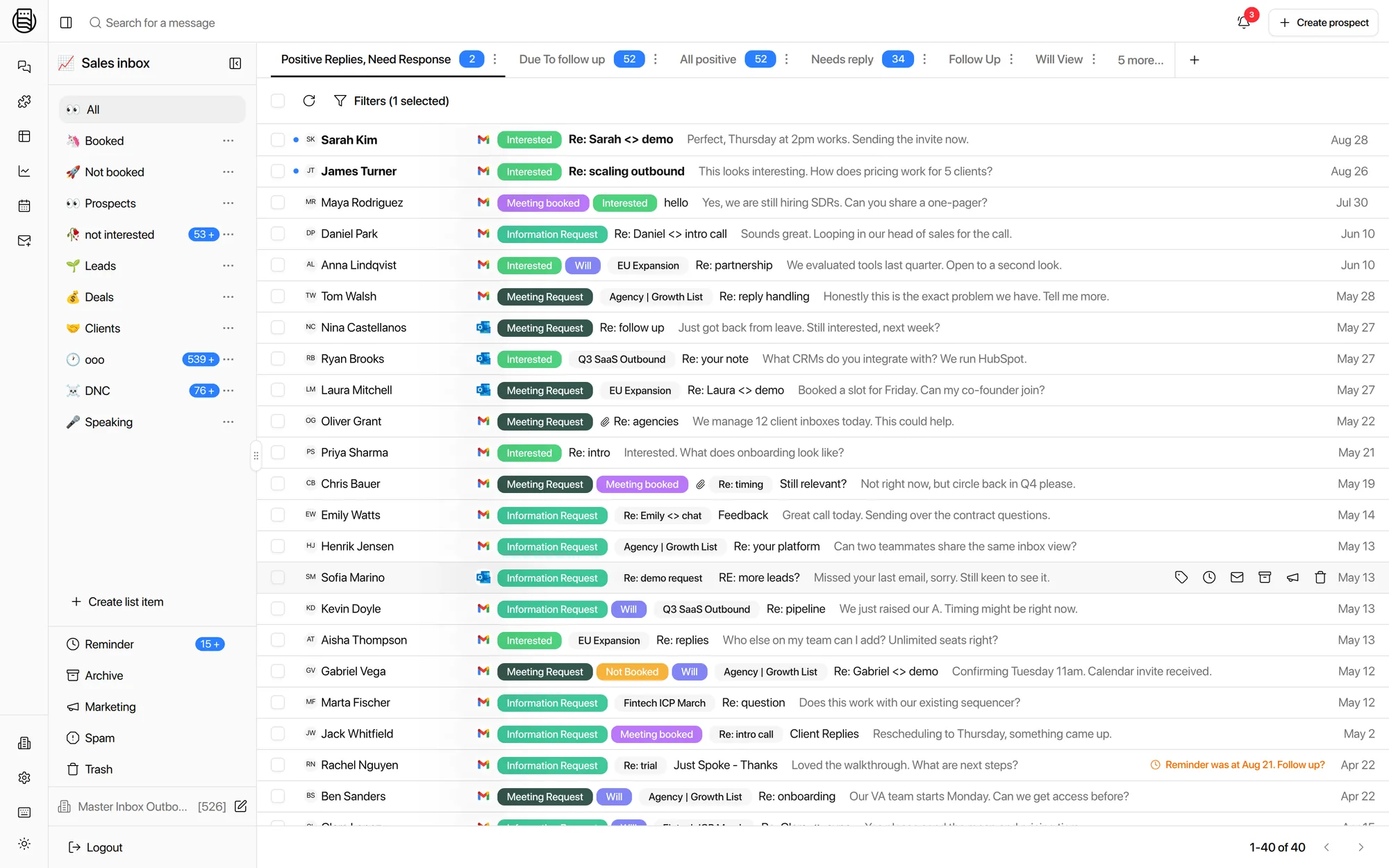
Master Inbox is purpose-built to solve the exact problem of capturing missed replies from cold outbound. It consolidates conversations from multiple channels (LinkedIn and unlimited email accounts) into a single, collaborative workspace. Instead of SDRs wasting hours sifting through inboxes, Master Inbox automatically categorizes replies, pauses follow-ups in your sending tools, and provides the analytics needed to manage performance.
It's more than just an inbox; it's a complete system for reply management. The platform's focus on being an SDR reply handling service means every feature is designed to make your outbound efforts more efficient and prevent leads from slipping through the cracks. This specialized approach makes it the most direct and effective solution on this list.
Standout features
- Unified Inbox: Combines replies from unlimited email accounts and LinkedIn profiles in one view.
- AI-Powered Categorization: Automatically tags replies as interested, objections, out-of-office, and more.
- Automated Follow-up Pausing: Integrates with popular sending tools to stop sequences once a reply is received.
- Team Collaboration: Assign conversations, leave notes, and track team performance with detailed analytics.
- Lead Labeling: Track lead progress, response times, and other key metrics for easy reporting.
Pros
- Drastically reduces the chance of missing a lead.
- Saves significant time for SDRs and account managers.
- Protects brand reputation by preventing irrelevant follow-ups.
- Provides a single source of truth for all outbound conversations.
- Actionable analytics to improve your outreach strategy.
Cons
- Adds another specialized tool to your sales tech stack.
- May require a short onboarding period to integrate with existing workflows.
- Pricing may be a consideration for very small teams or individual users.
Pricing approach
Master Inbox is tiered by connected mailboxes and client workspaces, with unlimited users on every plan. You can review the plans on their pricing page.
How it fits with Master Inbox
- Connect your team's email and LinkedIn accounts.
- Integrate your cold outreach tools (e.g., Instantly, Smartlead).
- Let Master Inbox automatically catch and categorize all incoming replies, allowing your team to focus only on the conversations that matter.
2) Email Client Rules & Filters (Gmail/Outlook)
Best for: Solopreneurs or very small teams with low outbound volume and no budget for dedicated tools.
Why it’s on this list
This is the default, DIY method. Using rules in Gmail or Outlook, you can create filters to automatically label or move emails containing keywords like “re:”, “unsubscribe,” or your campaign's subject line into specific folders. It’s a way to bring a semblance of order to a chaotic inbox and is often the first step teams take before realizing they need a more robust system.
Standout features
- Keyword-based filtering: Automatically sort emails based on words in the subject line or body.
- Automatic labeling: Apply labels (in Gmail) or move to folders (in Outlook) to group campaign replies.
- Forwarding rules: Can be configured to forward certain replies to a specific person or address.
Pros
- Completely free to use.
- Built directly into the email clients you already use.
- Highly customizable if you are skilled with boolean search logic.
Cons
- Does not stop follow-ups in your sending tool.
- Does not work for LinkedIn messages.
- Extremely brittle; a small change in a subject line can break the rule.
- No team collaboration or analytics features.
- Becomes unmanageable at any significant scale.
Pricing approach
Free.
How it fits with Master Inbox
- When to pair: You don't. This method is what you replace with Master Inbox.
- When to choose instead: Choose this only if you are a solo operator sending a very low volume of emails (e.g., <50 per day) and have no budget for a dedicated tool.
3) CRM Sales Engagement Hub (e.g., HubSpot, Salesforce)
Best for: Teams already heavily invested in a CRM ecosystem who want to keep all communication data logged against contact records.
Why it’s on this list
Most major CRMs offer sales engagement add-ons or features (like HubSpot Sales Hub or Salesforce Sales Engagement) that include some form of integrated inbox. These tools can log email replies to a contact's timeline and allow reps to manage conversations from within the CRM. This is a popular choice for companies that want a single system of record.
Standout features
- Automatic email logging: Replies are automatically attached to the correct contact record in the CRM.
- Task creation: Reps can create follow-up tasks directly from an email reply.
- Sequence management: Can automatically unenroll a contact from a sequence upon receiving a reply.
Pros
- Keeps all customer data and communication in one central place.
- Leverages your existing contact database and company information.
- Often included in a broader software suite your company may already pay for.
Cons
- Reply handling is often a secondary feature, not the core focus.
- LinkedIn integration is typically weak or non-existent.
- User interface can be clunky compared to a dedicated inbox tool.
- May not automatically pause sequences in third-party sending tools.
Pricing approach
Typically included as part of a premium CRM subscription tier (e.g., Professional or Enterprise plans).
How it fits with Master Inbox
- When to pair: Use your CRM as the master system of record for lead data, and use Master Inbox as the front-line communication hub. Master Inbox handles the messy work of catching and categorizing replies, ensuring reps can respond instantly, and then the outcome is logged in the CRM.
- When to choose instead: If your outreach is 100% email-based and your team lives inside the CRM all day, using the built-in tools might be sufficient.
4) Manual Auditing / Virtual Assistant (VA)
Best for: Agencies managing client inboxes or teams that prefer a human touch for interpreting and categorizing every reply.
Why it’s on this list
Before sophisticated automation existed, the only way to manage replies at scale was to assign a person to the task. Hiring a Virtual Assistant (VA) or dedicating an internal resource to monitor inboxes, categorize replies, and update the CRM is still a common practice. This method replaces software logic with human judgment.
Standout features
- Human interpretation: A person can understand nuance, sarcasm, and complex questions that AI might misinterpret.
- Flexible tasking: A VA can perform other admin duties, such as updating the CRM, booking meetings, and doing basic research.
- System-agnostic: A human can be trained to work across any set of tools you use.
Pros
- Excellent for handling replies that require nuanced understanding.
- Can handle a wide variety of administrative tasks beyond just inbox management.
- No need to purchase or integrate new software.
Cons
- Very expensive compared to software.
- Does not scale cost-effectively; more volume requires more hours or more people.
- Prone to human error, burnout, and slower response times (not 24/7).
- Poses a security risk, as it requires sharing access to sensitive inboxes.
Pricing approach
Billed hourly (e.g., $10-$50/hour depending on location and skill) or on a monthly retainer.
How it fits with Master Inbox
- When to pair: You can use Master Inbox to do the initial, heavy-lifting of catching and categorizing 95% of replies. A VA can then manage the categorized inboxes, focusing only on the high-intent replies that require a human response.
- When to choose instead: If you have a very complex reply-handling process that requires significant human judgment for every single message, a VA might be a better fit than a fully automated tool.
5) Custom Zapier/Make Automations
Best for: Tech-savvy marketing or sales ops teams who prefer to build and maintain their own custom solutions.
Why it’s on this list
For teams that love to build, automation platforms like Zapier or Make offer the building blocks to create a custom reply-handling system. You could create a "Zap" that watches a specific inbox, and when a new email arrives, it could parse the content, and then create a task in Asana, add a row to a Google Sheet, and send a Slack notification. This is the ultimate "build-it-yourself" approach.
Standout features
- Universal connectivity: Connects thousands of apps, allowing you to create a workflow tailored to your exact stack.
- Conditional logic: Build complex "if this, then that" workflows to handle different types of replies.
- Action-oriented: Designed to trigger actions in other systems, not just manage conversations.
Pros
- Almost infinitely flexible and customizable.
- Can be cost-effective if you are already paying for and using these tools for other processes.
- Gives you complete control over your data and workflow logic.
Cons
- Extremely complex and time-consuming to set up and maintain.
- Very "brittle", a small change in your process or an API update can break your entire workflow.
- Does not provide a user interface for actually managing the conversations.
- Requires significant ongoing technical expertise to troubleshoot and adapt.
Pricing approach
Usage-based subscription model, priced on the number of "tasks" or "operations" you run per month.
How it fits with Master Inbox
- When to pair: You can use Zapier to connect Master Inbox to a tool that it doesn't natively support. For example, when a lead is marked as "Interested" in Master Inbox, a Zap could trigger a workflow in your project management tool.
- When to choose instead: You would not choose this to build a reply management system from scratch unless you have a dedicated technical resource and a truly unique workflow that no off-the-shelf tool can support.
How to choose the right option (in 60 seconds)
- Do you manage replies from both LinkedIn and email? If yes, you need a unified inbox.
- Is your team larger than one person? If yes, you need collaborative features.
- Are you using a separate tool to send cold outreach? If yes, you need a way to automatically pause follow-ups.
- Are leads being missed because of a cluttered inbox? If yes, you need automated categorization.
- Is manually checking inboxes taking up more than 30 minutes of your day? If yes, your time is better spent elsewhere.
- Do you need to report on reply rates and response times? If yes, you need built-in analytics.
If you answered "yes" to two or more of these questions, your team will see a significant ROI from a dedicated reply management platform. The most direct path is to start with a tool purpose-built for the job, like the Master Inbox - Combine LinkedIn + Email solution.
FAQs
What's the biggest risk of not capturing missed replies from cold outbound?
The biggest risk is lost revenue. Every missed reply from an interested prospect is a lost sales opportunity. A secondary risk is brand damage, which occurs when you continue to send automated follow-ups to someone who has already replied, making your outreach look robotic and unprofessional.
How does a unified inbox help with capturing missed replies?
A unified inbox solves the problem of "channel switching." Instead of reps having to check multiple email accounts plus their LinkedIn inbox, all messages are consolidated into one place. This single queue ensures that no message can be overlooked or forgotten, as everything is visible in one workflow.
Can I just use Gmail filters to manage my cold outreach replies?
While you can use Gmail filters for very basic sorting, it's not a scalable solution. Filters are brittle, cannot stop follow-ups in your sending tool, don't support LinkedIn, and lack any team collaboration or analytics features. They are a temporary fix for very low-volume senders, not a professional system.
Is it better to automate reply handling or hire a VA?
For most teams, automation is better because it's more scalable, faster, cheaper, and less prone to human error. A tool like Master Inbox can process thousands of replies instantly, 24/7. A VA is better suited for situations where every reply requires deep, nuanced human interpretation that current AI cannot yet handle.
How does Master Inbox stop sending follow-ups to people who have already replied?
Master Inbox integrates directly with popular cold outreach platforms. When it detects a reply from any of your connected inboxes, it sends a signal back to the sending tool via API to automatically pause or stop any future scheduled follow-ups to that specific prospect. This closes the loop and prevents embarrassing mistakes.
Final recommendation
Choosing the right method for capturing replies depends entirely on your team's scale and maturity. If you're a solopreneur just starting out, manual filters or a simple CRM inbox might suffice. But the moment you have a team, are using multiple channels like LinkedIn and email, or are sending outreach at any significant volume, the risk of missed replies becomes a major financial liability.
For any serious outbound team, a dedicated, purpose-built platform is the clear winner. It eliminates manual work, protects your brand, and ensures every potential lead gets the attention it deserves. By centralizing your conversations, you transform your reply management from a chaotic liability into a streamlined, revenue-generating asset.