
4 Smart Ways to Handle Cold Email Reply Management
On this page
- Key takeaways (the 5 things that matter)
- What we evaluated (criteria)
- Quick comparison table
- 1) Master Inbox
- 2) CRM with Sales Automation (e.g., HubSpot Sales Hub)
- 3) Sales Engagement Platform (e.g., Outreach)
- 4) Manual System (Gmail/Outlook Filters + Spreadsheets)
- How to choose the right option (in 60 seconds)
- FAQs
- Final recommendation
Managing replies from a cold email campaign is where the real work begins. For every hundred emails you send, a handful of replies land in your inbox, some positive, some objections, some out-of-office. Without a system, this quickly becomes chaotic. Leads get missed, follow-ups are delayed, and potential revenue slips through the cracks. This is a critical pain point for outbound sales teams, SDRs, and B2B agencies whose success hinges on converting conversations into qualified meetings.
A structured approach to cold email reply management ensures every response is handled quickly and correctly. It separates the hot leads from the noise, allowing your team to focus their energy on prospects who are ready to talk. Tools like Master Inbox are purpose-built to solve this challenge, creating a central command center for all your outbound conversations.
Key takeaways (the 5 things that matter)
- Speed to Lead: The faster you respond to an interested prospect, the higher your chance of booking a meeting. A good system prioritizes positive replies instantly.
- Inbox Unification: Your prospects communicate across multiple channels. Managing LinkedIn and multiple email inboxes in one place is no longer a luxury; it's a necessity.
- Accurate Categorization: Manually sorting replies is slow and error-prone. AI-driven categorization automatically identifies intent (Interested, Objection, Not a Fit) so you can act accordingly.
- Team Collaboration: Reply management is a team sport. Your system should make it easy to assign conversations, leave internal notes, and track performance without stepping on each other's toes.
- Actionable Analytics: Tracking metrics like response rates, positive reply rates, and time-to-reply helps you understand what's working. A dedicated SDR reply handling service can provide deep insights into campaign performance.
What we evaluated (criteria)
We analyzed this category of reply management solutions based on the criteria most critical for outbound sales success.
- Inbox Unification (Email + LinkedIn)
- AI-Powered Reply Categorization
- Team Collaboration Features
- Response Time Tracking
- Integration Capabilities
- Scalability for High Volume
- Analytics and Reporting
- Ease of Use
Quick comparison table
| # | Tool / platform | Best for | Biggest strength | Biggest tradeoff | Pricing approach |
|---|---|---|---|---|---|
| 1 | Master Inbox | Unified LinkedIn & email reply management | AI-powered inbox for outbound teams | Not a full-suite CRM or SEP | Tiered SaaS |
| 2 | CRM with Sales Automation | Teams already using an all-in-one CRM | Centralized contact and deal data | Clunky for high-volume reply triage | Tiered, per-seat |
| 3 | Sales Engagement Platform | Enterprise teams needing end-to-end outbound | Powerful sequencing and analytics | High cost and implementation complexity | Quote-based |
| 4 | Manual System (Filters + Sheets) | Solo users or teams with zero budget | Completely free to implement | Highly manual and error-prone | Free |
1) Master Inbox
Best for: Outbound teams and agencies needing a unified inbox to manage LinkedIn and email replies efficiently.
Why it’s #1 for this list
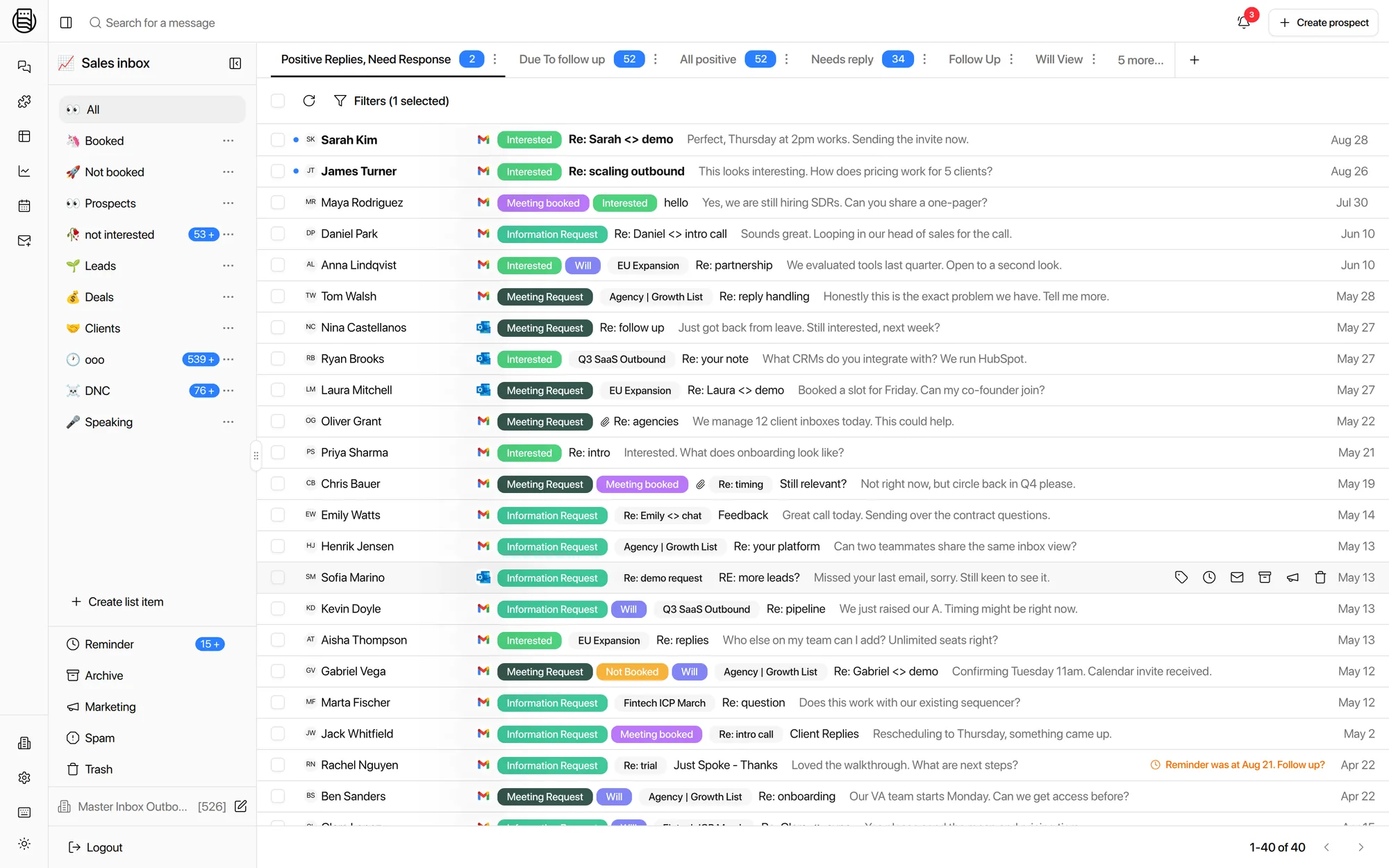
Master Inbox is purpose-built to solve the exact problem of cold outreach reply management. Unlike generic inboxes or complex CRMs, it focuses on one thing: creating a single, intelligent command center for all your sales conversations. By unifying multiple email accounts and LinkedIn inboxes, it eliminates the need to constantly switch between tabs, saving time and ensuring no lead is ever missed.
The platform uses AI to automatically categorize incoming replies, allowing sales reps to instantly see who is interested, who has an objection, and who is unsubscribing. This focus makes it the most direct and effective solution for any team serious about scaling their outbound efforts. It's a powerful tool that offers a clear path to better outbound communication and performance.
Standout features
- Unified Inbox: Connect multiple email accounts and LinkedIn profiles into a single view.
- AI Reply Detection: Automatically categorizes replies as Interested, Objection, Question, etc.
- Team Collaboration: Assign conversations, leave notes, and track team activity in one place.
- Lead Tracking: Monitor reply rates, lead progress, and response times with built-in analytics.
- Prevents Unnecessary Follow-ups: Automatically stops sequences once a reply is received.
Pros
- Drastically reduces time spent on manual inbox management.
- Prevents valuable leads from getting lost in the shuffle.
- Improves response time to interested prospects.
- Provides a clear overview of all outbound conversations.
- Simple to set up and integrate into existing workflows.
Cons
- It is not a full-suite CRM; it's designed to work alongside one.
- Primarily focused on the reply management stage of the sales cycle.
Pricing approach
Master Inbox uses tiers based on connected mailboxes and client workspaces, with unlimited users on every plan. Specific details for each plan are available on their pricing page.
How it fits with Master Inbox
- Connect your email and LinkedIn accounts to create your unified inbox.
- Launch your cold outreach campaigns as usual.
- Use the Master Inbox dashboard to triage all incoming replies, focusing first on the ones categorized as 'Interested' by the AI.
2) CRM with Sales Automation (e.g., HubSpot Sales Hub)
Best for: Teams already embedded in an all-in-one CRM ecosystem who want to manage replies within their existing platform.
Why it’s on this list
For many businesses, the CRM is the center of the universe. Using a CRM's built-in sales tools, like a shared inbox or basic automation, is a common first step toward managing replies. It keeps all data, from initial contact to closed deal, in one system of record, which is a major advantage for reporting and pipeline management. While not as specialized as a dedicated tool, it's a realistic and accessible option for teams with low-to-moderate reply volume.
Standout features
- Shared Team Inbox: A central inbox within the CRM for team members to manage conversations.
- Email Templates and Snippets: Create and reuse common replies to speed up responses.
- Contact Activity Logging: Automatically logs email replies to the contact's timeline in the CRM.
- Basic Workflow Automation: Trigger tasks or notifications based on email replies.
Pros
- All customer data and communication are in one place.
- Leverages a tool your team already knows how to use.
- Part of a larger platform with marketing, sales, and service hubs.
- Strong reporting capabilities across the entire sales funnel.
Cons
- Lacks native LinkedIn inbox integration.
- Can become cluttered and inefficient for high-volume reply management.
- AI features are generally less sophisticated for specific reply intent analysis.
- Not purpose-built for the speed required in outbound sales triage.
Pricing approach
Most CRMs offer tiered, per-seat pricing. Features like shared inboxes and automation are typically included in paid plans (e.g., Professional or Enterprise tiers).
How it fits with Master Inbox
- Pair: Use Master Inbox as the specialized 'triage' layer at the top of your funnel. Once a lead is qualified in Master Inbox, push it to your CRM for long-term nurturing and deal management. This gives you the best of both worlds.
- Replace: If your reply volume is low and your team lives inside your CRM, you might choose to manage replies there directly to keep your tool stack simple.
3) Sales Engagement Platform (e.g., Outreach)
Best for: Large or enterprise sales teams needing a comprehensive, end-to-end platform for all outbound activities.
Why it’s on this list
Sales Engagement Platforms (SEPs) like Outreach and Salesloft are the heavyweights of the outbound world. They go far beyond reply management to cover every aspect of sales engagement, including multi-step, multi-channel sequencing, automated dialing, conversation intelligence, and deep analytics. Reply management is a core feature within these platforms, designed to work seamlessly with their powerful sequencing engines. For teams that need this level of power and can handle the complexity, an SEP is a formidable choice.
Standout features
- Advanced Sequencing: Build complex outreach cadences across email, phone, and social.
- AI-Powered Insights: Provides real-time guidance during calls and helps prioritize tasks.
- Deep CRM Integration: Offers robust, bi-directional sync with Salesforce and other major CRMs.
- Comprehensive Analytics: In-depth reporting on every aspect of sales activity and performance.
Pros
- An all-in-one solution for prospecting and engagement.
- Extremely powerful for managing complex sales cycles at scale.
- Excellent for standardizing processes across large SDR teams.
- Market-leading features and integrations.
Cons
- Very high cost, often prohibitive for smaller teams.
- Can be overly complex and require significant training and implementation.
- May be overkill if your primary pain point is just inbox management.
Pricing approach
Pricing is typically quote-based and geared toward enterprise customers. It is not publicly listed.
How it fits with Master Inbox
- Pair: A company could use an SEP like Outreach to generate replies at scale, but then use Master Inbox's SDR Reply Handling Service to manage the actual conversations. This frees up expensive SDRs to focus on demos and closing, not inbox admin.
- Replace: An SEP is a direct replacement for a stack that includes a separate tool for reply management. You would choose an SEP if you need its full suite of capabilities.
4) Manual System (Gmail/Outlook Filters + Spreadsheets)
Best for: Solo founders, freelancers, or very small teams on a strict budget who are just starting with cold outreach.
Why it’s on this list
This is the default, DIY method. By combining email filters or labels (e.g., "Reply: Interested," "Reply: Objection") with a Google Sheet or Excel spreadsheet for tracking, you can build a rudimentary reply management system for free. It's how many successful outbound campaigns begin. This approach highlights the core tasks involved in reply management and makes the value of paid tools crystal clear once the manual effort becomes overwhelming.
Standout features
- Zero Cost: Uses tools you already have (email client and spreadsheet software).
- Infinite Flexibility: You can design your tracking system exactly how you want it.
Pros
- It's completely free.
- Uses familiar, accessible tools.
- Forces you to understand the fundamentals of the reply management process.
Cons
- Extremely time-consuming and does not scale.
- Highly prone to human error (e.g., missed replies, incorrect data entry).
- No collaboration features; impossible for a team to use effectively.
- No analytics or performance tracking.
- Doesn't integrate with LinkedIn.
Pricing approach
Free.
How it fits with Master Inbox
- Replace: The manual system is what you graduate from. As soon as your outreach generates a consistent flow of replies, or the cost of one missed lead outweighs the cost of software, you should replace this method with a dedicated tool like Master Inbox.
- Pair: There is no scenario where you would pair a manual system with Master Inbox.
How to choose the right option (in 60 seconds)
- Do you need to manage replies from both LinkedIn and email?
- Is your team spending more than 30 minutes a day just sorting the inbox?
- Have you ever lost a potential lead because a reply was missed?
- Is your primary goal to increase SDR efficiency and response speed?
- Do you need a simple way to see which campaigns are getting positive replies?
- Is your current CRM too clunky for fast-paced reply triage?
- Are enterprise-level SEPs too expensive or complex for your needs?
If you answered "yes" to several of these questions, a dedicated reply management tool is your best bet. If you need a focused, affordable solution to unify your inboxes and stop missing leads, start with Master Inbox.
FAQs
What is cold email reply management?
Cold email reply management is the process of systematically handling, categorizing, and responding to the replies generated from your outbound email campaigns. The goal is to quickly identify interested prospects, handle objections, and filter out irrelevant messages to maximize conversion opportunities.
Why is managing replies so important for cold outreach?
A reply is the first sign of success in a cold campaign. Effectively managing these replies ensures that interested leads are engaged immediately, increasing the chances of booking a meeting. Poor management leads to missed opportunities, a damaged brand reputation, and wasted effort.
How can AI help with cold email reply management?
AI can automatically analyze the text of a reply to determine its intent. It can instantly categorize messages as 'Interested', 'Objection', 'Question', 'Not Interested', etc. This saves hours of manual sorting and allows sales reps to focus their attention on the most promising conversations first.
Can I manage replies from both LinkedIn and email in one place?
Yes, but not with traditional tools. A specialized platform like Master Inbox is designed to create a unified inbox that brings together conversations from multiple email accounts and your LinkedIn inbox, providing a single screen to manage everything.
What's the difference between a reply management tool and a full CRM?
A reply management tool is a specialist, focused on the top-of-funnel task of triaging conversations from outbound campaigns. A CRM is a generalist, designed to be the system of record for the entire customer lifecycle, from lead to long-term customer. Many teams use both: a reply tool for speed and efficiency at the top, and a CRM for deep data management.
Final recommendation
Choosing the right system for cold email reply management depends on your team's size, volume, and budget. If you're just starting out, a manual system is a viable, if temporary, solution. For teams already living in an all-in-one CRM, using its native tools can work for low reply volumes.
However, for any B2B team, agency, or SDR serious about scaling outbound without losing leads, a dedicated tool is non-negotiable. Master Inbox offers the most focused and efficient solution by unifying LinkedIn and email with smart, AI-driven categorization. It directly solves the biggest time-sinks and risks in the process, providing a clear and immediate return on investment.